For this project, I wanted to make connections between my interests and my work, including what I achieved in project 2, in order to create a series of illustrations.
I already knew that I wanted to explore editorial illustrations as I have had an interest in that kind of illustrations for a long time. There is also a connection with my work as I work in presentation design, and illustrations are often used by companies to illustrate some text or data in brochures or annual reports for instance.
Before defining a brief for that project, I needed to carry out some research.
Define editorial illustration
I was not entirely sure that what I had in mind could be described as editorial illustration. There is the type of illustrations used by newspaper such as the Guardian to illustrate an article. However, sometimes there is a fine line between editorial and advertising illustration. For instance, if a company uses images in one of their brochures to market their products or their activity, it could be perceived as both.
I did some research online to have a clearer idea of the different types of illustrations.
According to the Association of illustrators (https://theaoi.com/inside-illustration/editorial-season/editorial-illustration-basics/), the aim of an editorial illustration is “to help the reader to understand the text and maybe make it more approachable and enticing”.
On their website, the Rocky Mountain College of Art (https://www.rmcad.edu/blog/editorial-illustration-visual-storytelling-for-magazines-and-newspapers/#:~:text=Conceptual%20illustrations%20are%20a%20form,the%20article%20or%20editorial%20work. (Rocky Mountain College of Art – Design) describes the different categories of editorial illustration: Conceptual (where the artists has more freedom and the final image illustrates the text), infographics and visual data as well as portrait and character illustrations. I am more interested in illustrations that illustrate a concept and infographics.
The audience for editorial illustrations can vary: It could be the reader of a newspaper or a magazine, the customer of a company or an investor in the case of financial reports.
I also looked at editorial illustrations on websites such as https://www.illustrationx.com/uk/styles/editorial, https://folioart.co.uk/illustration/style/editorial-illustrations/ and https://www.agoodson.com/styles/editorial-illustrators/.
I compared the editorial sections with other sections such as advertising and fashion and often noticed the same artists in different categories.
I concluded that I was interested in illustrations that help to tell a story alongside some information in the form of text or data in materials such as newspapers, magazines, brochures and reports. Such an illustration could be descriptive or it could be a collage. Metaphors are often used. It is important to note that when the illustration is for a given company, it might mean that there will be some constraints in terms of colours for instance. This is one important difference between editorial and advertising.
Research about style
I looked again at editorial illustrations in the 3 websites mentioned above to understand what I like in terms of style and how it relates to my work.
I first created a “messy” gallery in PowerPoint where I copied a lot of snapshots and sorted them by category.
I then choose my favourite illustrations and again looked at what they had in common. I ended up with four main categories.
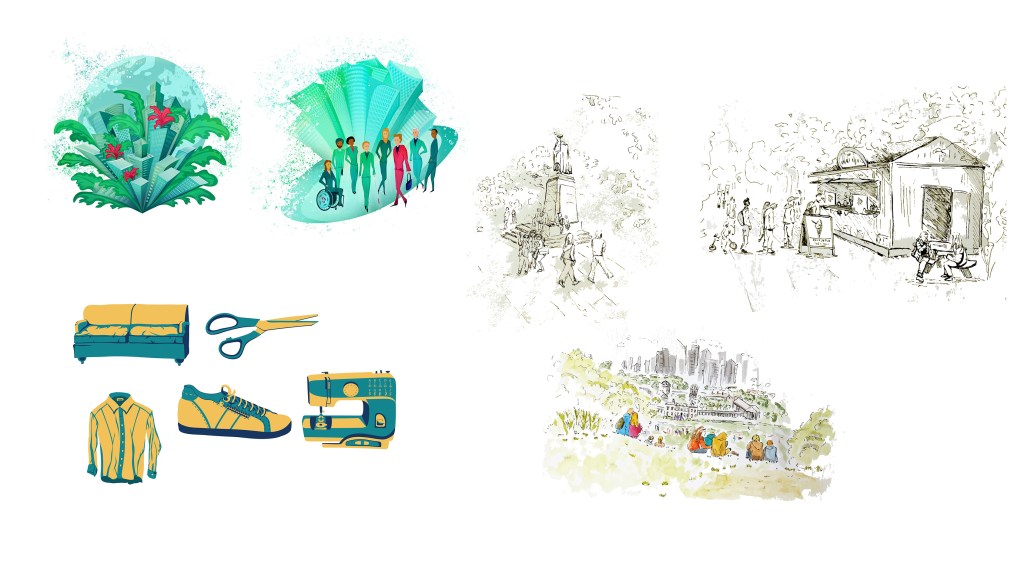
1 and 2: Illustrations that are created or could be created in Illustrator (defined shapes) – I divided these illustrations into two types: Minimalist illustrations and more detailed ones.
Below are a few examples of these illustrations.
When it comes to minimalism, I particularly like how Malika Favre (https://www.malikafavre.com/pages/travel) uses only a few shapes to tell a story. It is interesting to remove one by one all the elements that are not essential to define a person, a building or any other element in a few lines.
I noticed Colin Elgie’s work on illustrationx.com (https://www.illustrationx.com/uk/artists/ColinElgie). I often work with Illustrator and solid shapes and really like how his work is very detailed with some strong contrast.
3 Digital illustrations in a painted style
I have explored this kind of illustration in more depth as part of the previous project and would like to keep experimenting with that style.
4. Illustration with mark making
I like illustrations that use mark making or some kind of patterns instead of solid fill. There are many different techniques with different effects.
I particularly like the work of Studio Duco (https://www.illustrationx.com/uk/artists/StudioDuco). I was always interested in traditional illustrations such as John Tenniels’s drawings of Alice in Wonderland and wonder if I could combine the digital and traditional in some way.
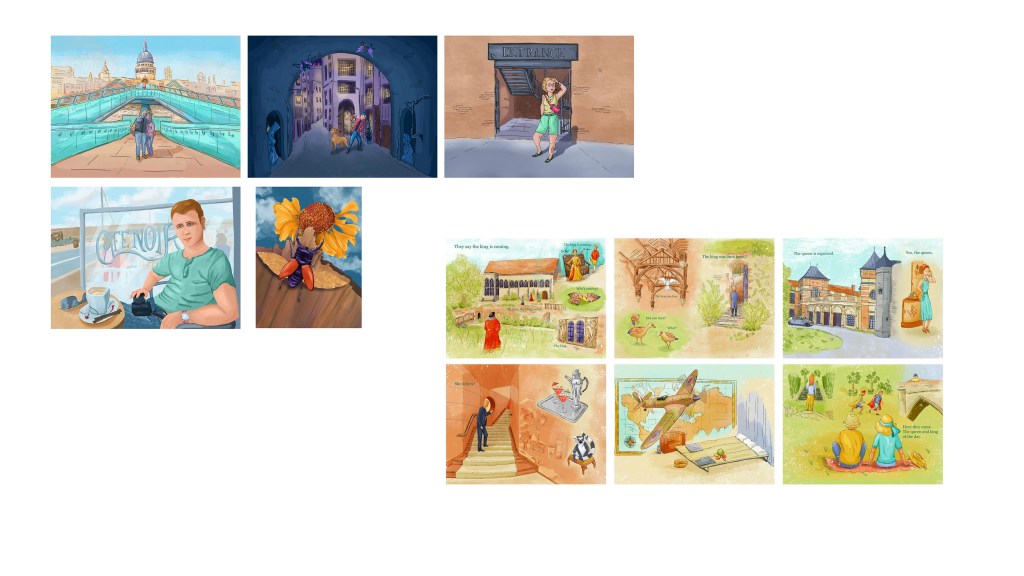
I also looked at my work and selected some pieces that could relate to editorial illustrations.
While carrying out my research, I also experimented with various techniques on Procreate to see how I could achieve certain outcomes.
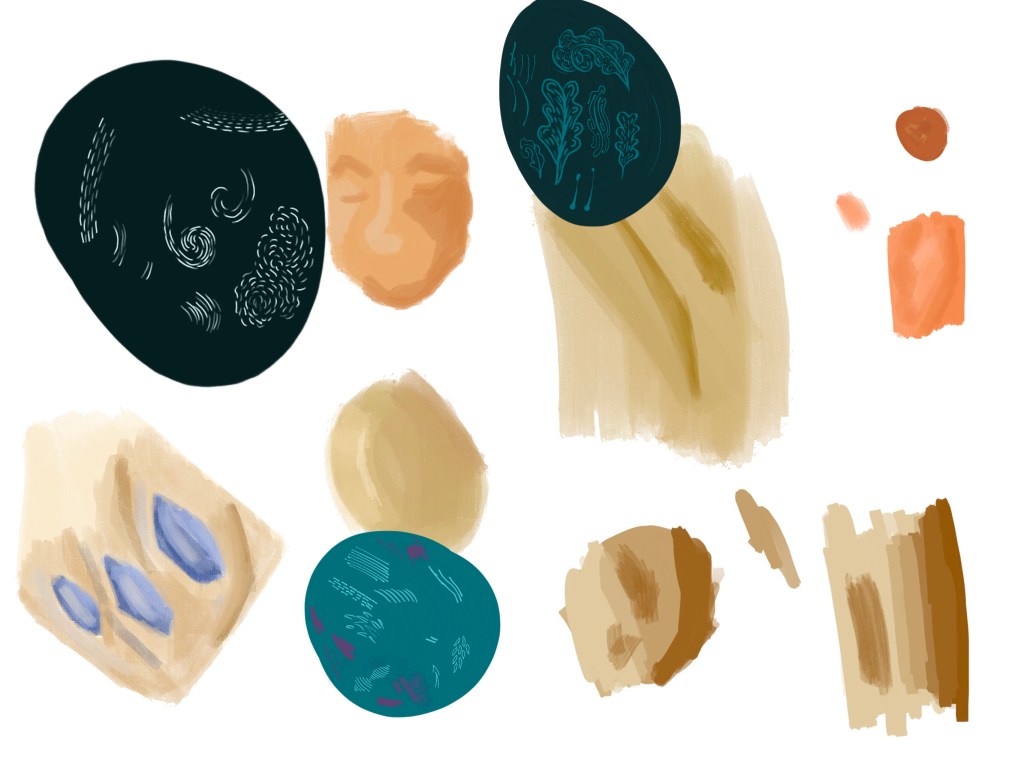
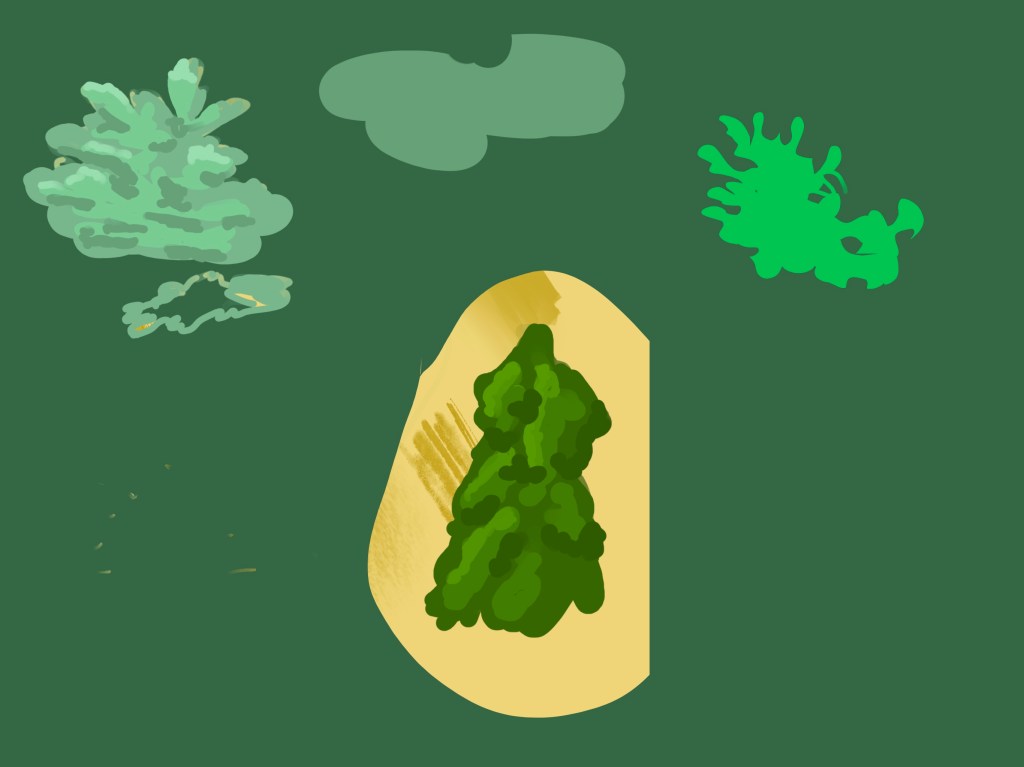
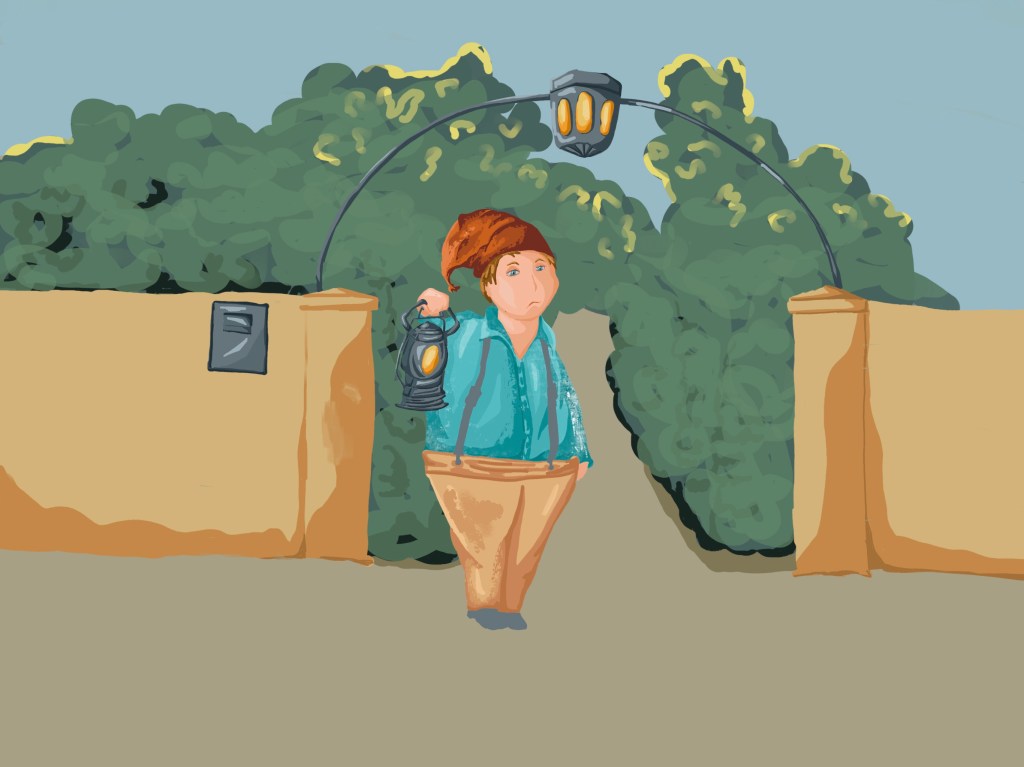
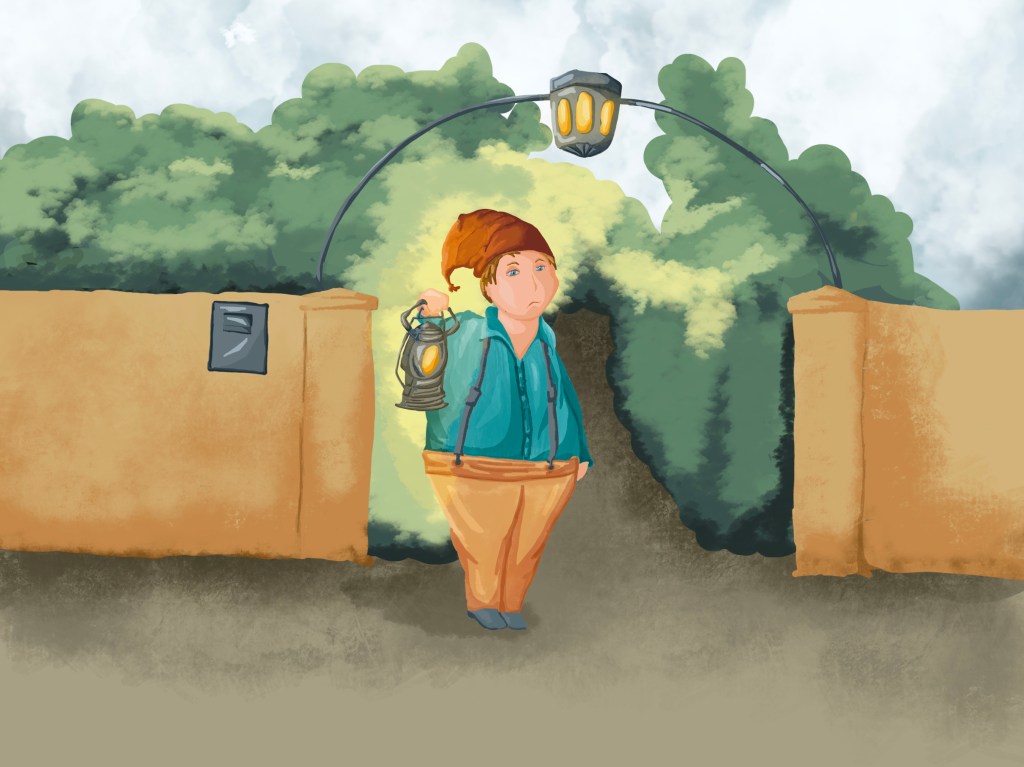
Once I had a better idea of styles, I looked at my interests, what I had done and how I could define a brief that would enable me to explore further editorial illustrations.
I put all my ideas in the forms of a mind map to see where the connections were. My handwriting is not easy to ready, but I have added a typed final version to give an idea of my thought process.
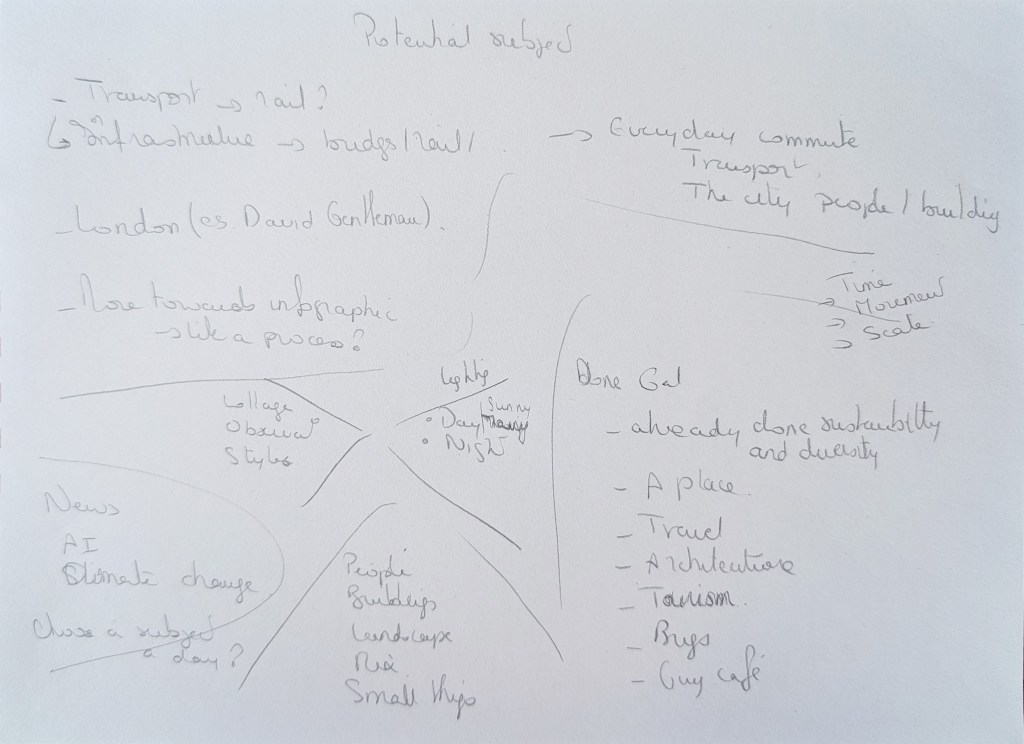

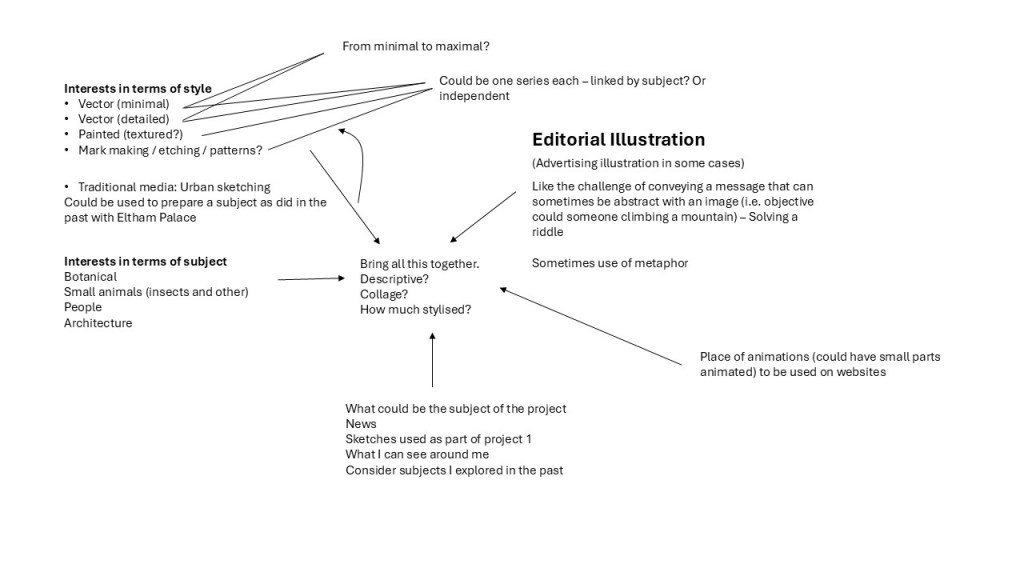
News can change all the time, and I thought it would not be very practical to illustrate the news for that project. I had already explored subjects such as climate change and sustainability in other projects. In a previous unit, the brief was to illustrate a place, and I thought I could do something similar but from a different angle. I live near Greenwich in London, and it would be good to select a place that is easy to reach. If I looked at different perspectives, I could create illustrations that would work as editorial illustrations.
I have created sketches in the park as part of a previous project, but this is a very rich area in terms of history, people, buildings and there is much to discover yet through illustrations.
I thought that my brief could be:
Illustrate Greenwich from different perspectives:
- Illustrate a sense of scale in Greenwich through a series of digital illustrations in a painted style.
- Illustrate time and history in Greenwich with a series of digital illustrations that would include some mark making.
- Illustrate time of year and day in Greenwich through a series of vector illustrations.
- Potentially illustrating the concept of time in general through a series of minimalist illustrations.
I would start with exploring the area further, take photos and create sketches to get a feel of the place and some inspiration.
This is quite an ambitious project and if I created 3 illustrations per series, it would mean that I would have about 7 hours per illustration. I might have to be less ambitious and reduce the number of illustrations depending on the complexity of the subject and the composition.
 Catherine Roux Degree in Illustration