When I last reflected on my progress with regular sketching, I decided on a timeline. The idea was to focus mainly on two areas: the human anatomy and more detailed sketches with black lines and watercolour. However, after a holiday followed by a cold, I struggled a bit and had some days when I did not sketch. I doubted my progress and did not really know how to carry on. I thought that this feedback point could be an opportunity to look at what I had done, what I would have liked to do and how to proceed in the future.
I decided to check my work first, carry out some research and look for solutions to the challenges I had met.
Observations on what I did since my last feedback
Commute
Below are some of the sketches I took during my commute.
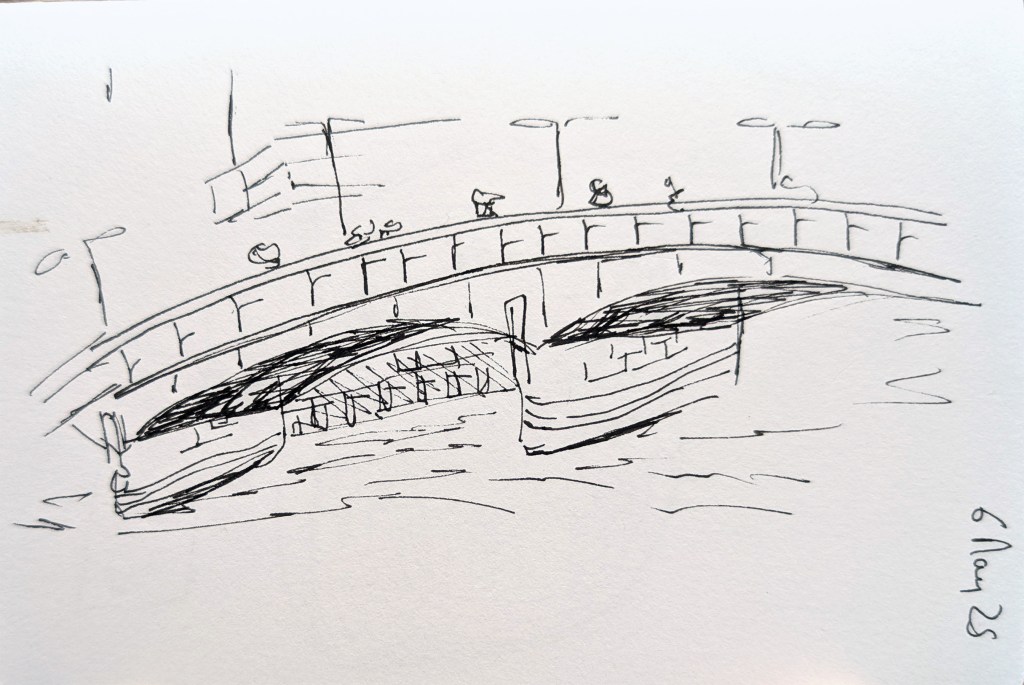
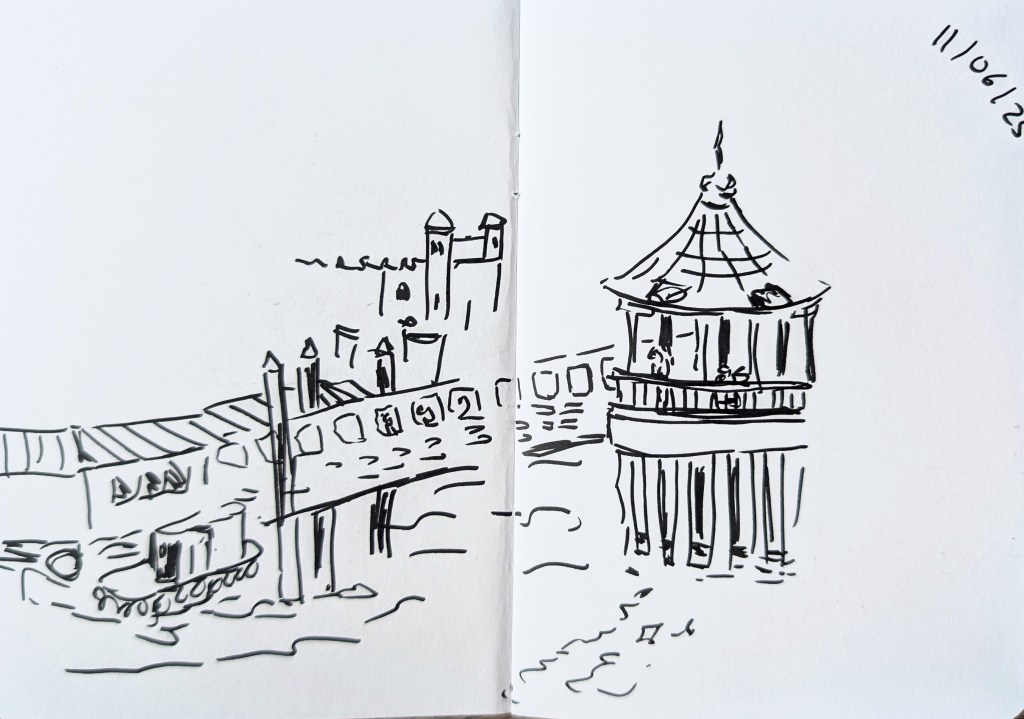

I still sketched a bit during my commute. A few times, I stopped on my way back to sketch the landscape (on the Thames near London Bridge). At the time, I felt that the exercise was quite difficult and I was not convinced by the outcomes. In retrospect, these sketches could have some potential and it would be worth carrying on and add thicker lines and shadows to show some contrast.
Anatomy
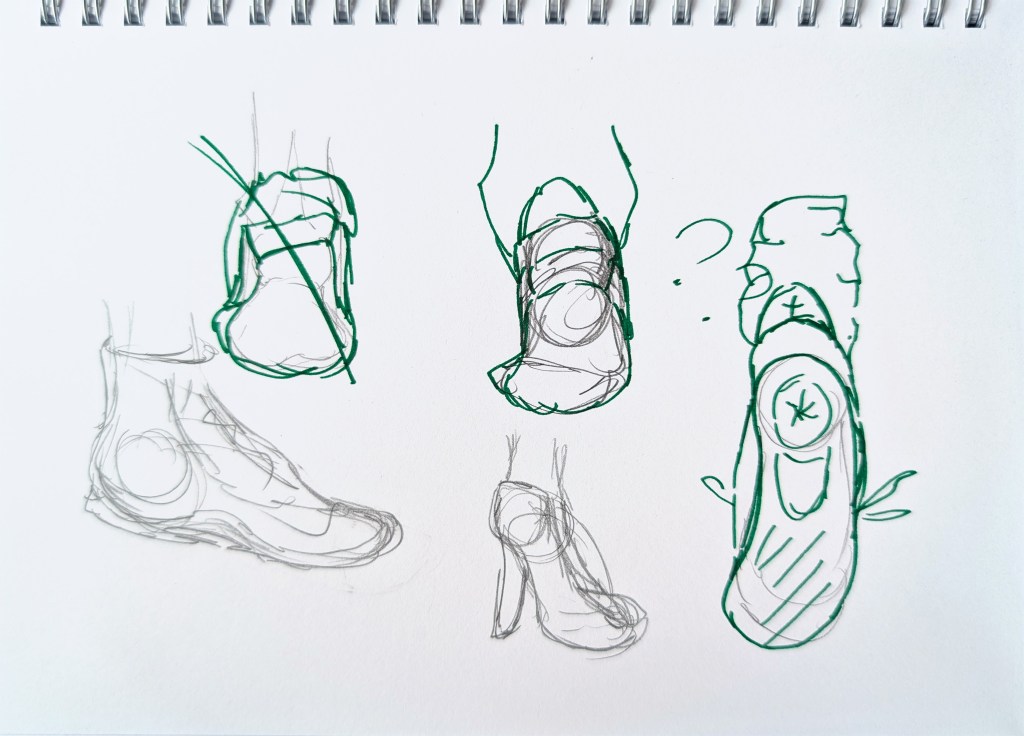
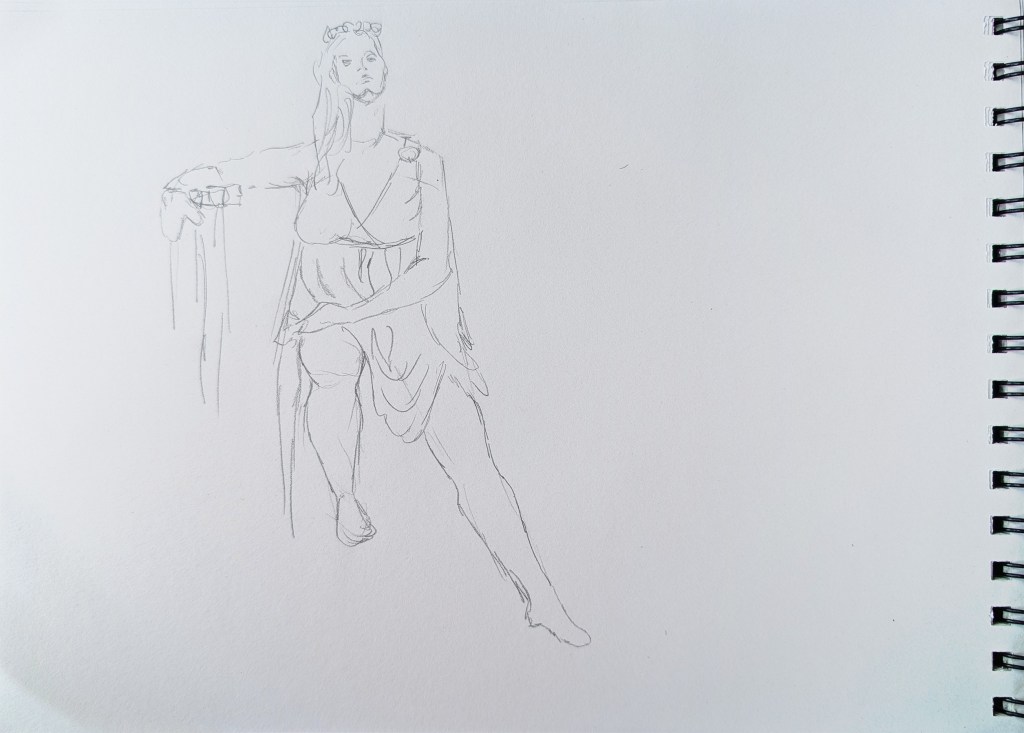
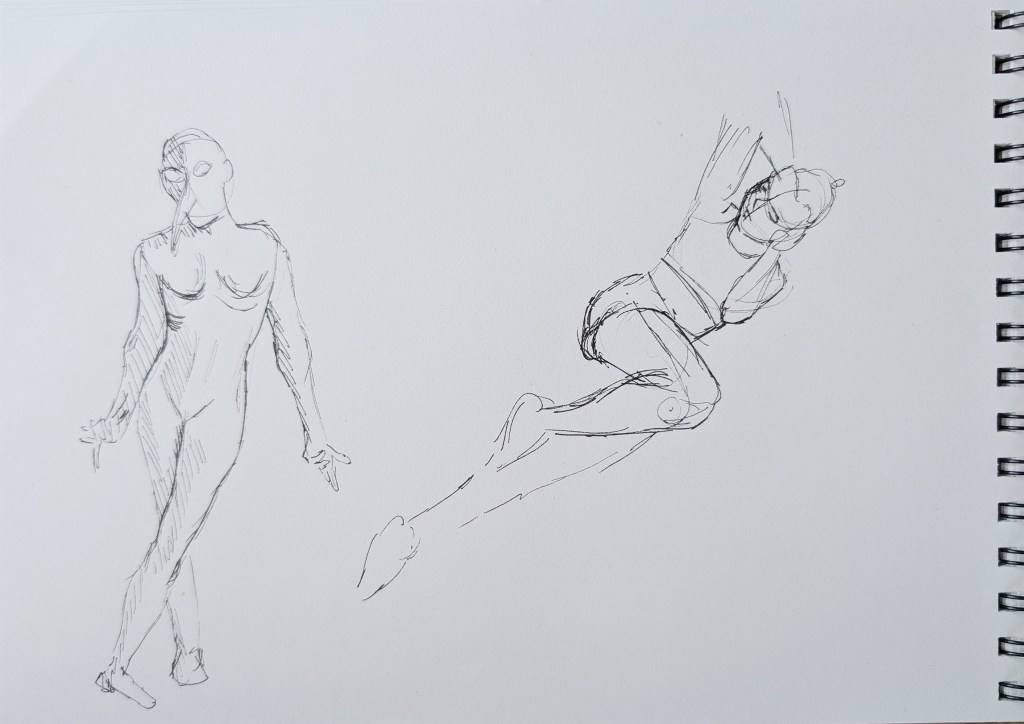
I completed a course that I had started with Udemy (How To Draw – Anatomy and Figure Drawing – Ultimate Course by Ed Foychuk). The course was very useful and helped me to understand better the human anatomy. I feel more confident to draw different postures.
Below are a few of the sketches I created while following the course.
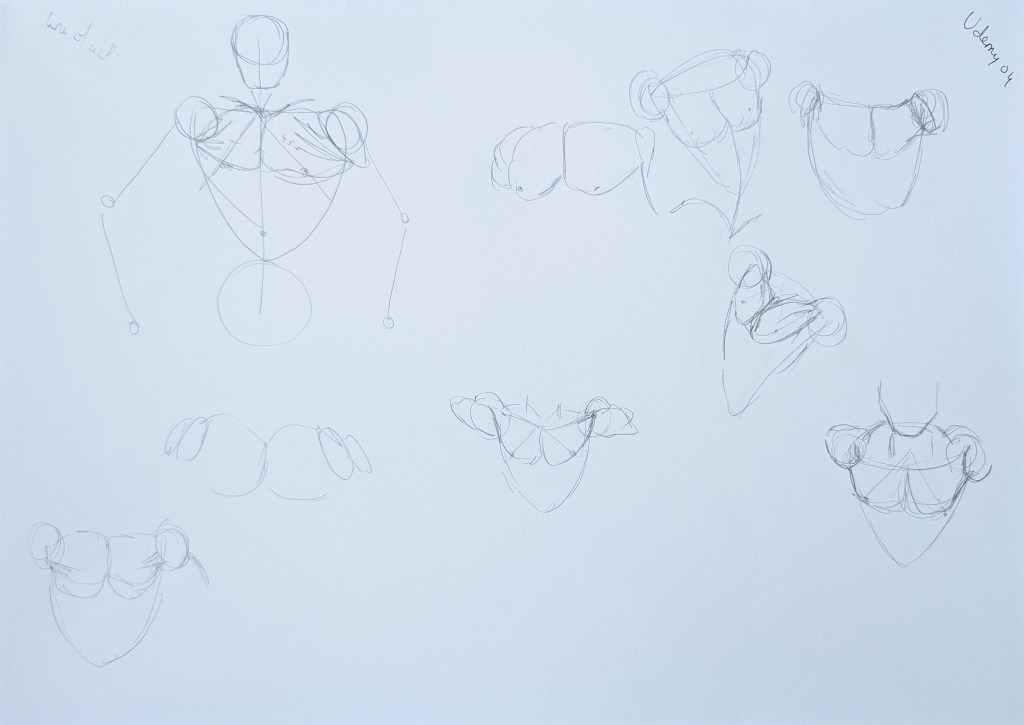
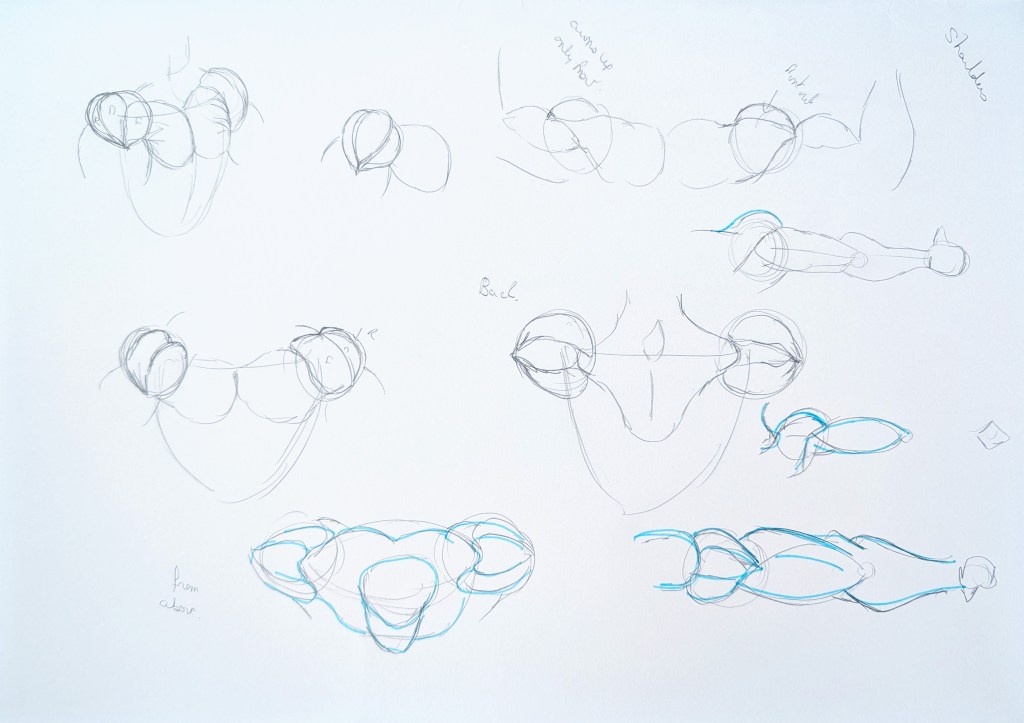
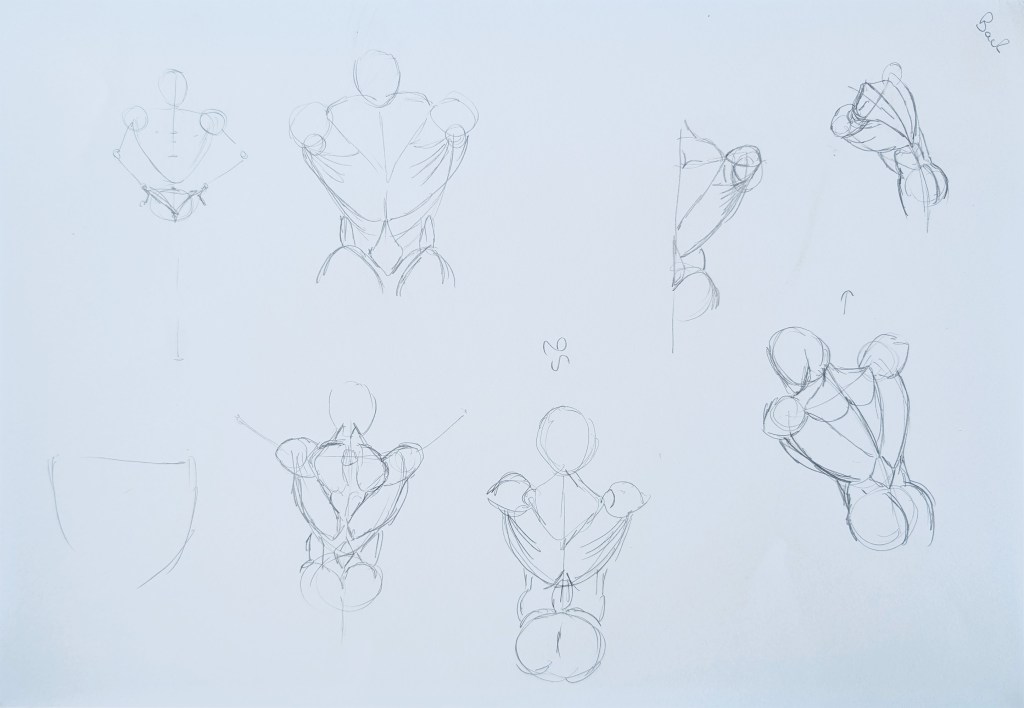
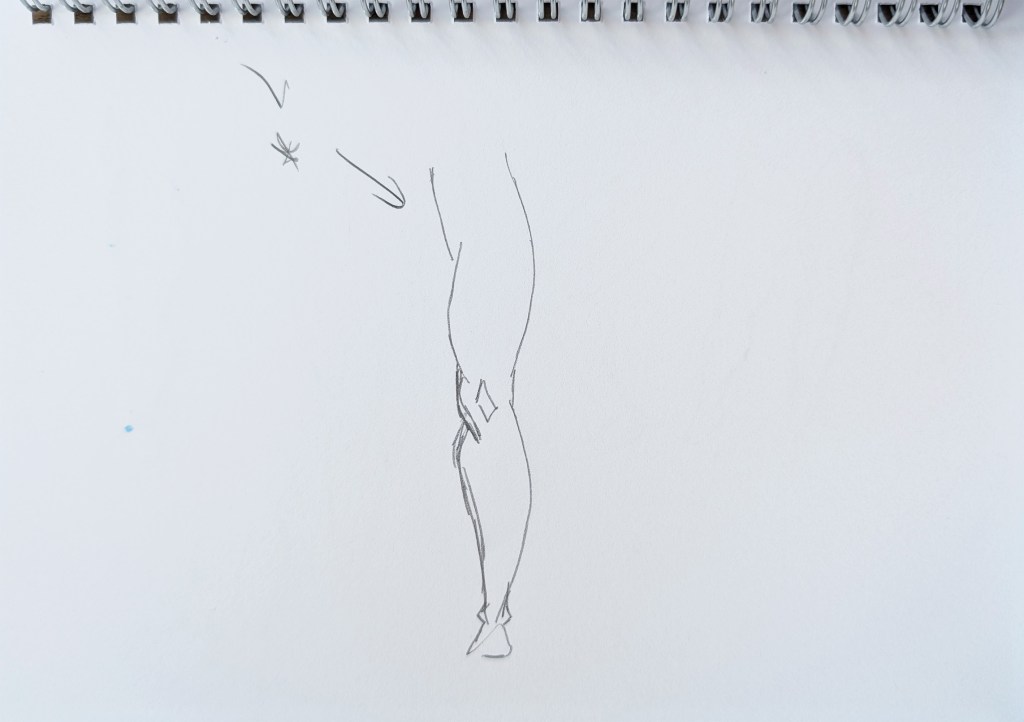

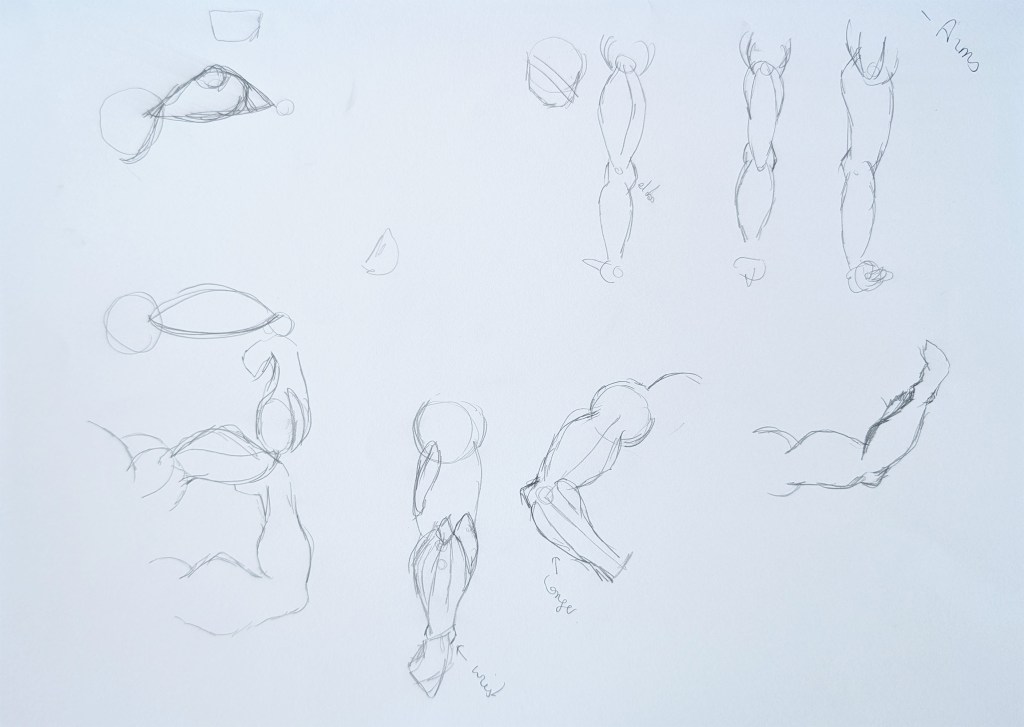
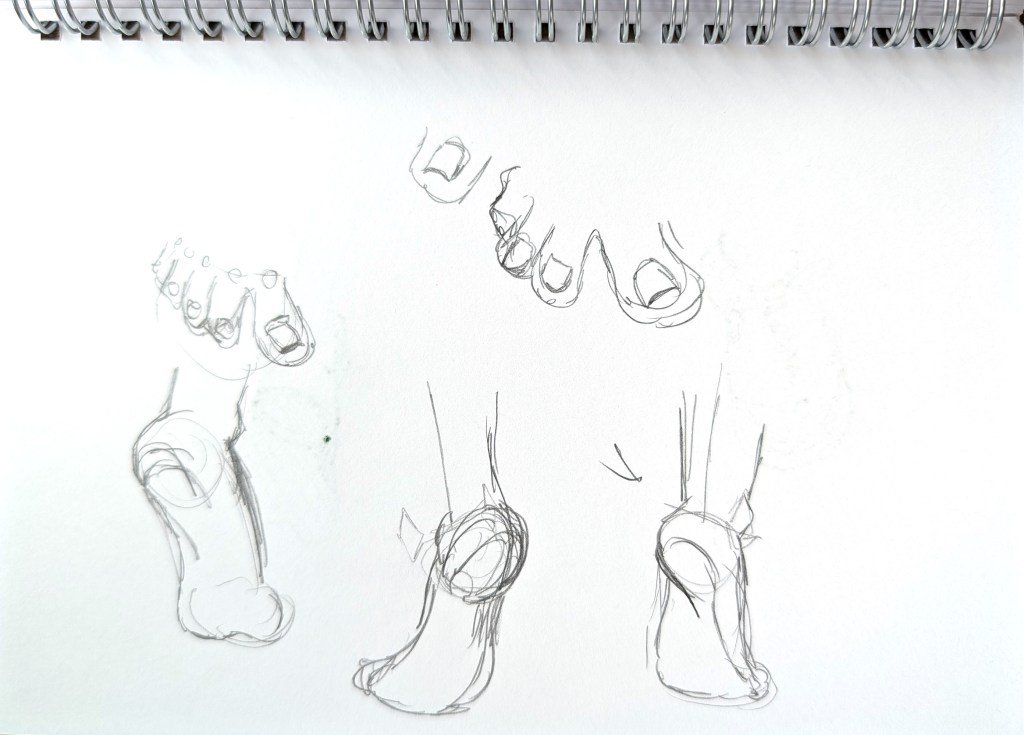
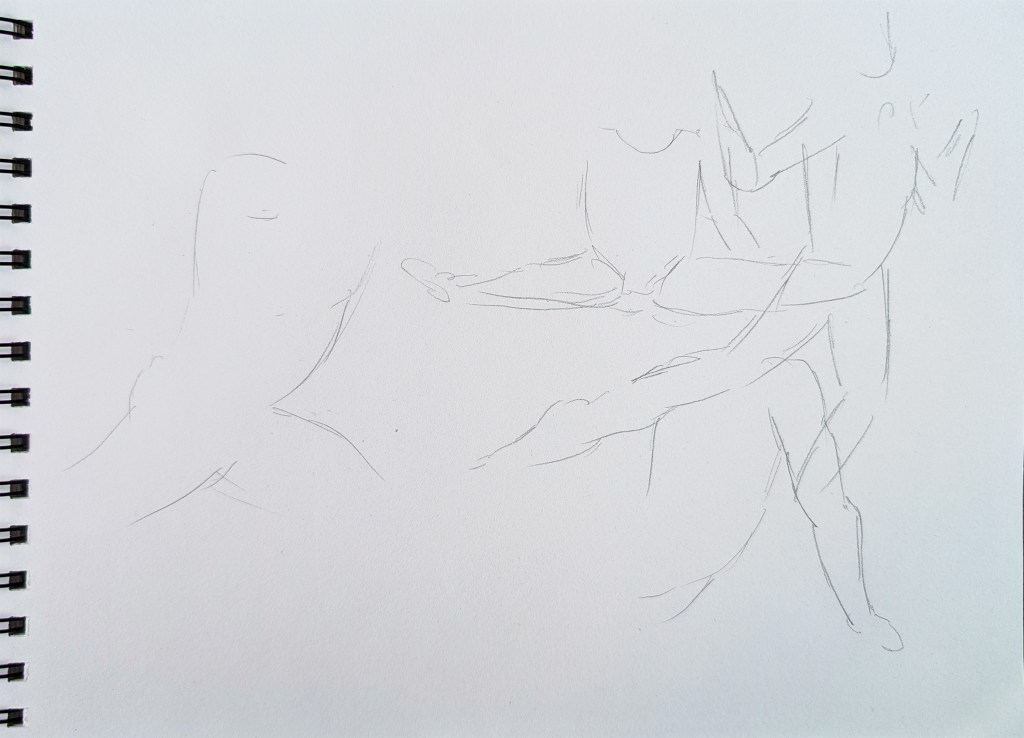
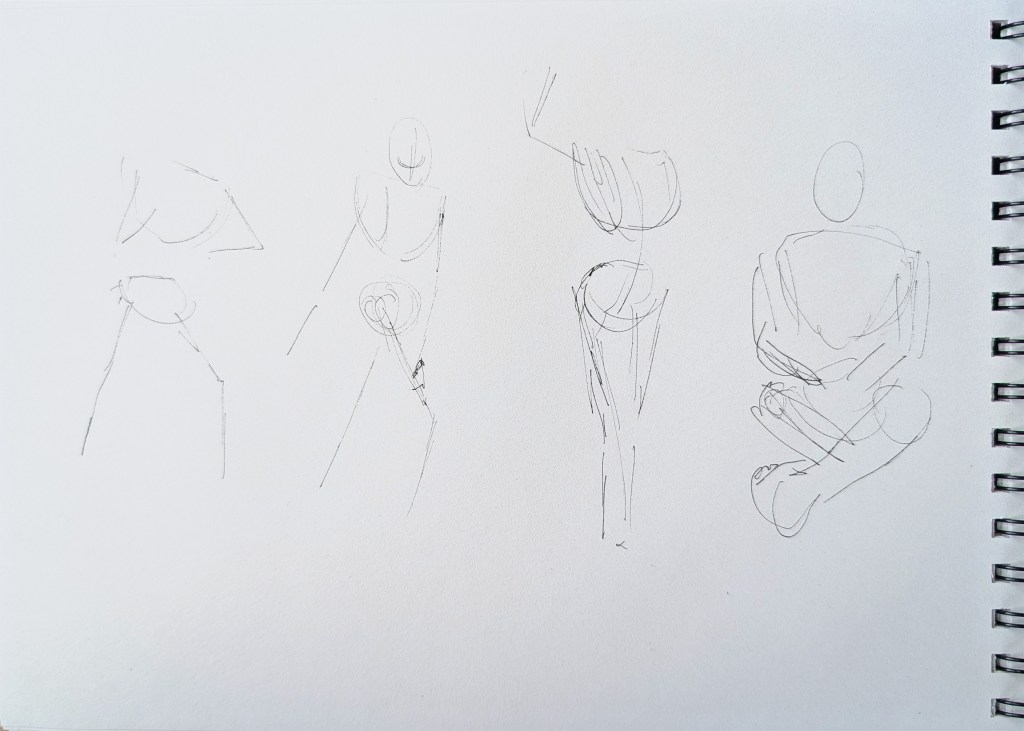
At the same time, I carried on sketching with online drawing classes. I have not done this often recently, but it is worth going back to this exercise regularly to learn to capture postures better.
On location
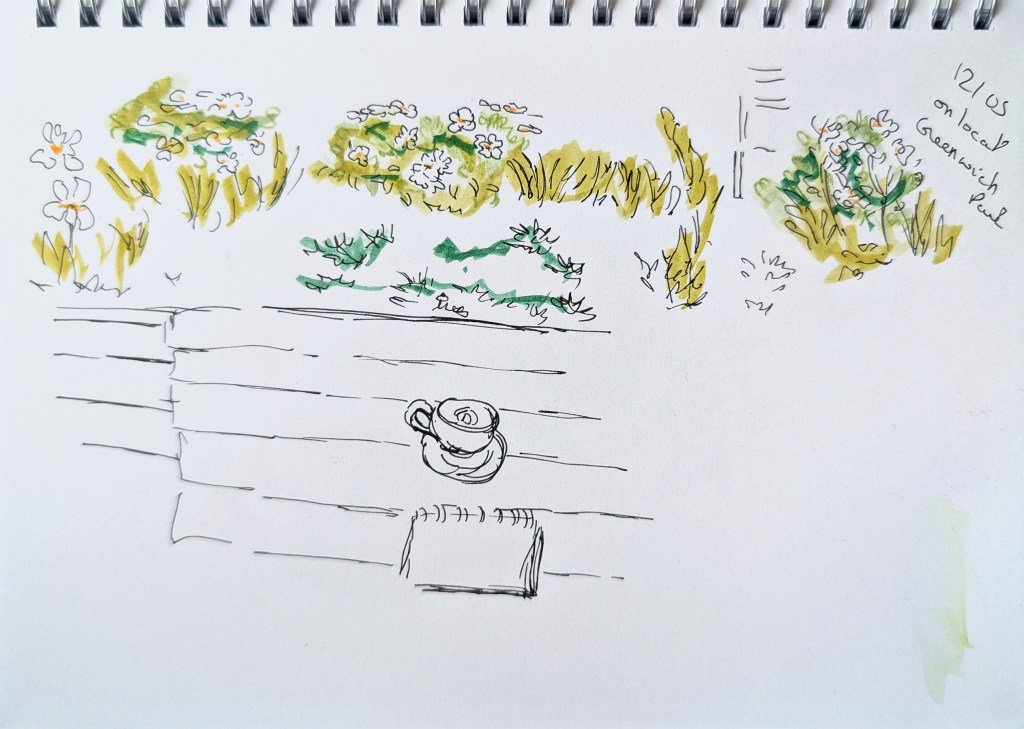
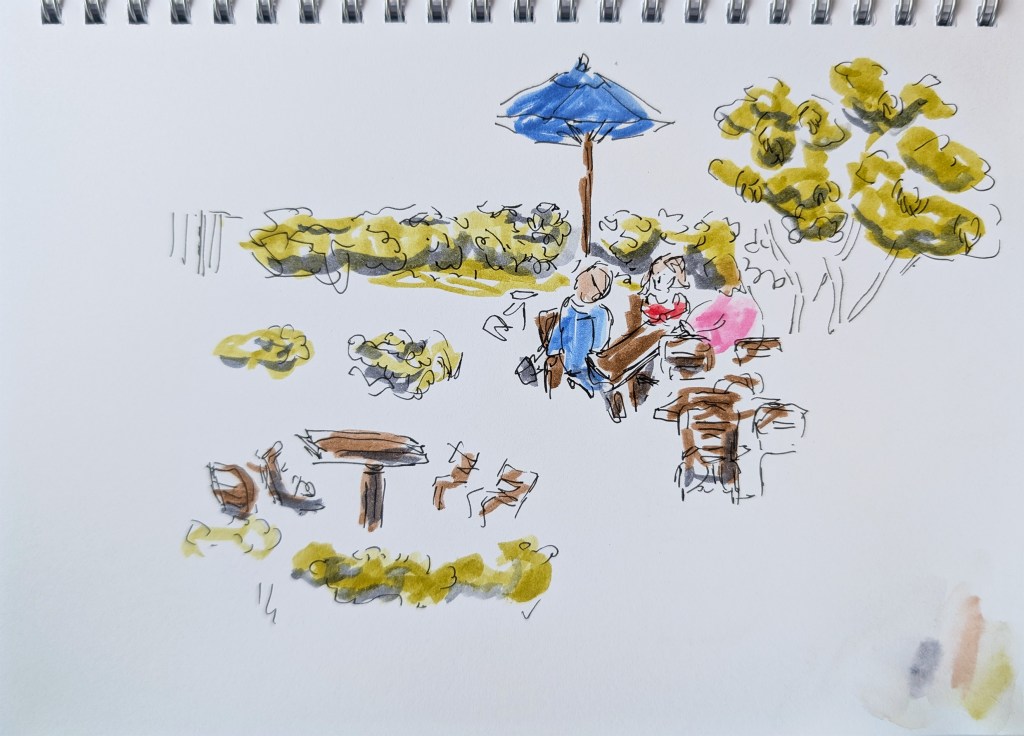
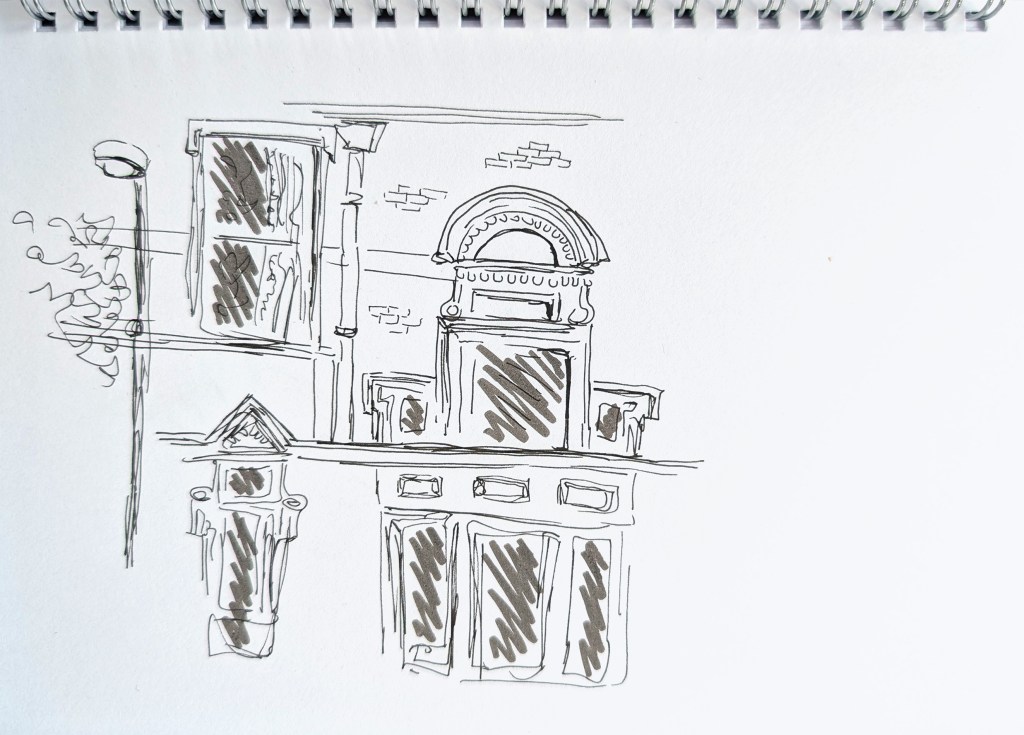
I have not created sketches on location very often. This is probably what I find the most challenging when it comes to regular sketching. This time I have used some watercolour brush pens I have had for a while. On one hand, I like the practicality of watercolour brush pens and watercolour pencils, but on the other hand I tend to prefer the outcome when I use watercolour paint.
TV
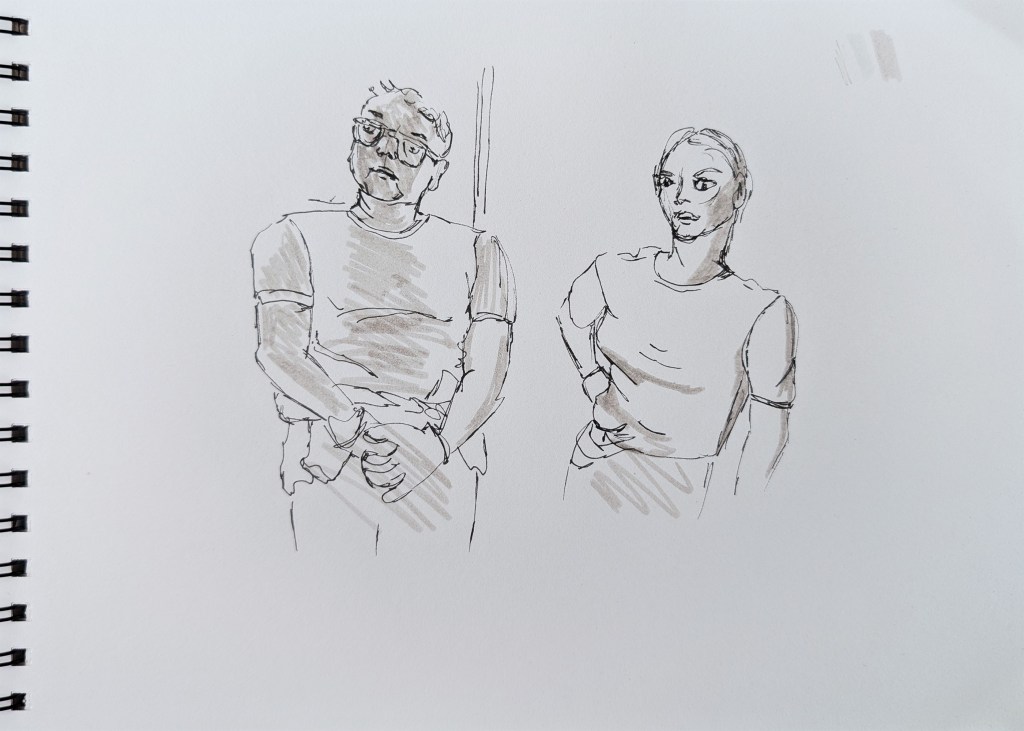
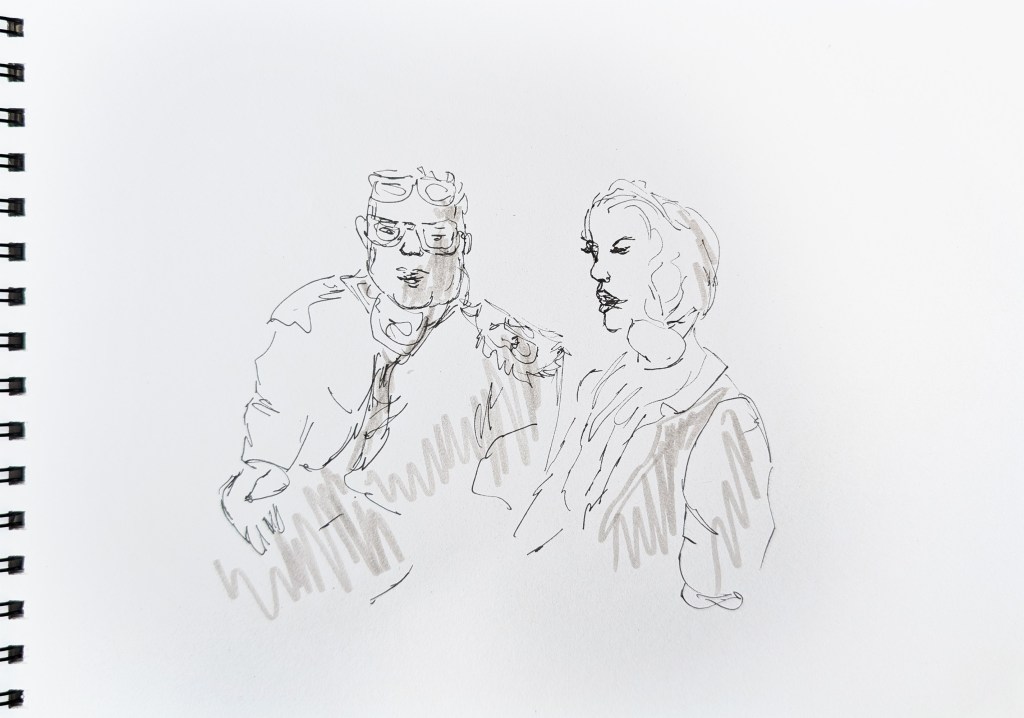
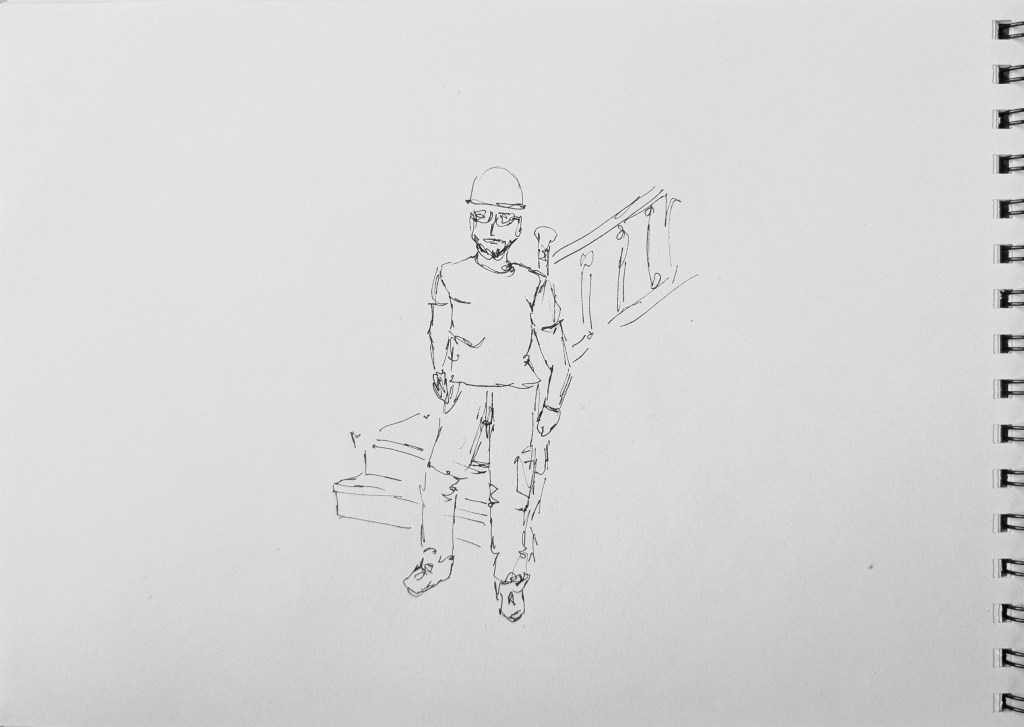

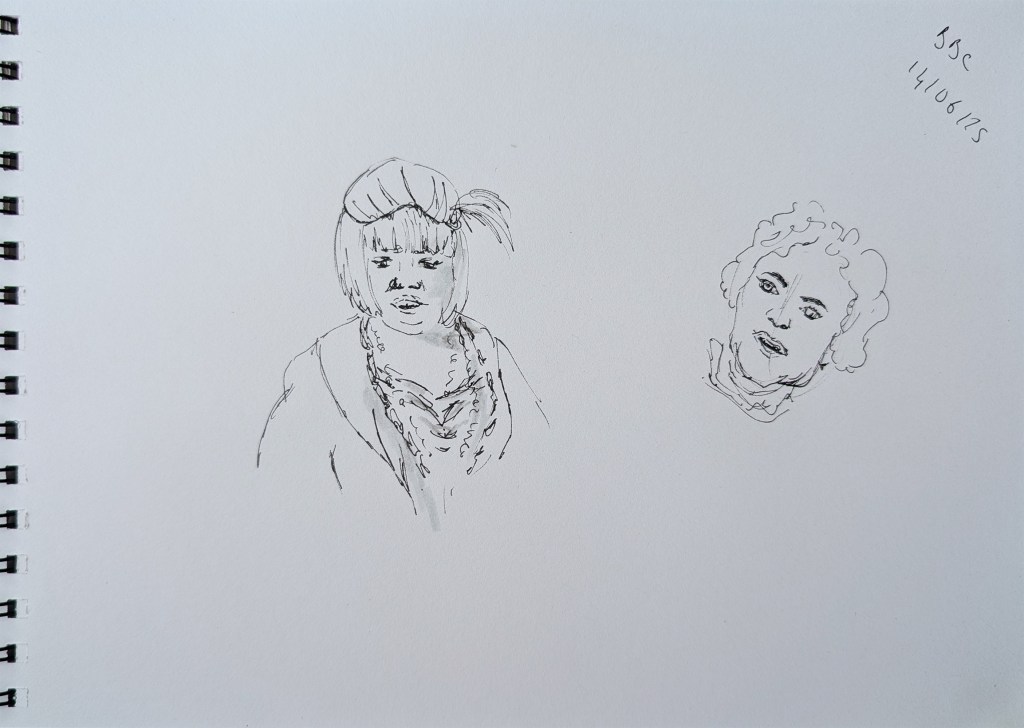
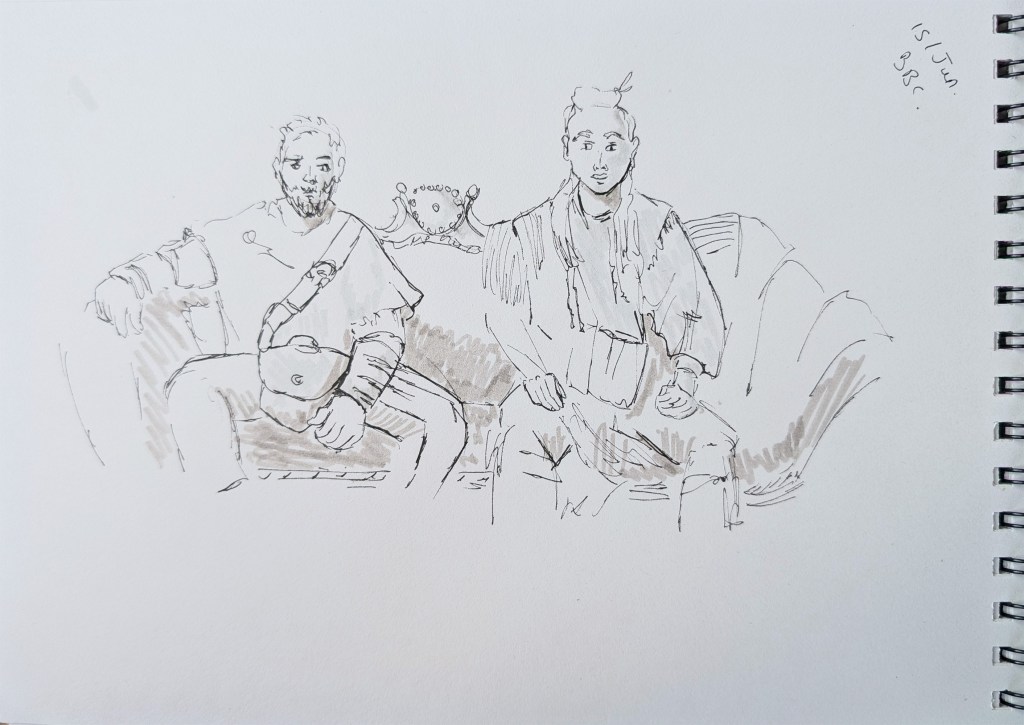
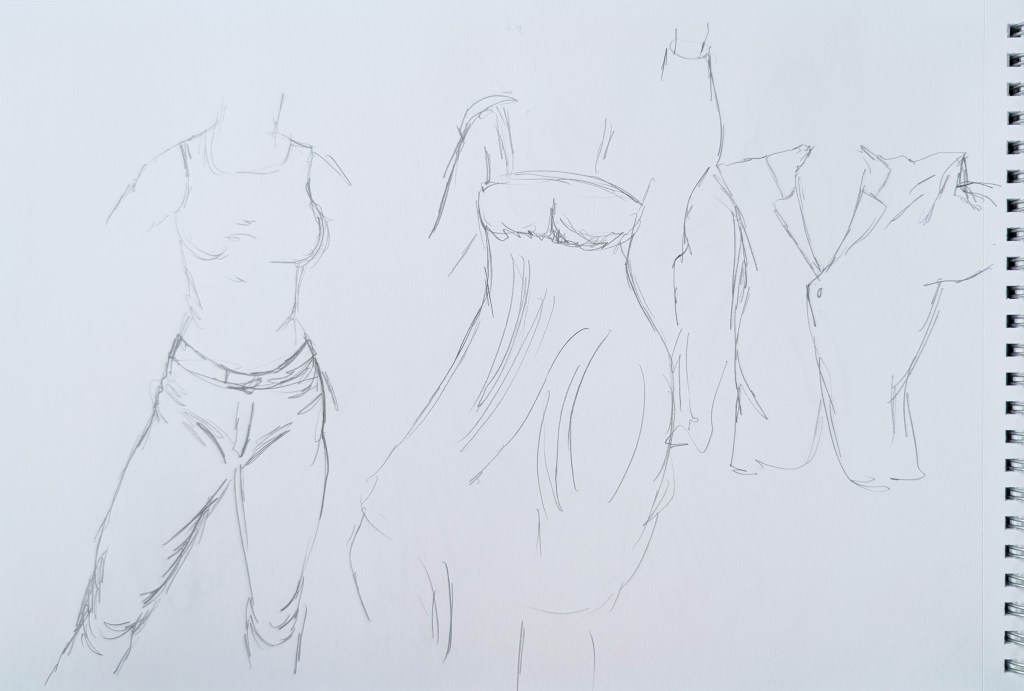
I enjoy stopping a TV programme and sketching for 10 minutes or so when I do not have much time. It can be an opportunity to draw a variety of things such as period costumes for instance as there are so many programmes available.
Sketches from photos with watercolour
I have not done any of these this time. It might be because it tends to take longer and I do not always find the right moment. Part of me also feels that I should sketch on location and not from a photograph although I enjoy spending more time to create a sketch from a picture at home.
Research
I thought that some more research would help me to understand my practice better, but I needed to carry out the research a bit differently this time.
I decided to list questions I had and challenges I had met and try to answer some of these questions by looking at the work of artists I like, particularly urban sketchers.
I gathered a few examples on a Pinterest board to see side by side the type of sketches I particularly like:
I then watched a few YouTube videos of artists who show how to use certain techniques or deal with particular difficulties.
(1) Line and Wash Watercolour Tutorial for Beginners – Step by Step Urban Sketch – TobySketchLoose (https://www.youtube.com/watch?v=71lPMn5MwvU&list=PLK50PnxS7WimXM_b7HfSp3OjaVH1Wh2CR)
(2) 4 tips for busy artists – urban sketching advice #urbansketching – @UrbanSketchCourse (https://www.youtube.com/shorts/g4MEN2a_3dg)
(3) How To Sketch ANYTHING! | Street Objects For Urban Sketching – Sketching Scottie (https://www.youtube.com/watch?v=-pLppm3sDQc)
(4) How to sketch PEOPLE quickly & accurately! – Sketching Scottie – (https://www.youtube.com/watch?v=-iw1QkyB2p8)
I revisited the work of some artists (I find Instagram particularly useful as artists often post videos and comments about the media or the techniques they use):
(5) Suhita Shirodkar (https://www.instagram.com/suhitasketch/?hl=en)
(6) Stephanie Bower (https://www.instagram.com/stephanieabower/?hl=en)
(7) Virginia Hein (https://www.instagram.com/stephanieabower/?hl=en)
(8) Ch’ng Kiah Kiean (https://kiahkiean.com) (https://www.instagram.com/kiahkiean/?hl=en)
(9) Renato Palmuti (https://www.instagram.com/renatopalmuti/?hl=en)
(10) George Butler (https://www.georgebutler.org/)
I then tried to answer the following questions:
- How to find inspiration? What to draw?
Some artists specialise in particular areas: Stephanie Bower (6) often sketches churches or monuments with attractive symmetries and Virginia Hein’s sketches (7) regularly depict nature. Suhita Shirodkar’s sketches (5) tend to illustrate busy areas.
Looking at their work made me realise that I do not need to find something extraordinary to sketch. I like sketching interesting buildings and there are many of them around me. I sometimes fear that I could repeat myself but drawing the same place several times can have some advantages. It is a good way of learning. I also like nature, and I am often walking in the park.
I am not very comfortable to draw people in detail on location and find it easier to use photographs.
I do not find sketching at home very inspiring as it feels that I have already sketched every object over the years, but I can carry on sketching from TV programmes, online drawing classes…
- How do these artists approach colour? Do they colour everything or only part of the sketch and if they do, which part? Do they follow contours exactly or apply colour loosely?
I enjoy adding colours loosely, but I often feel that I need to colour the entire sketch. In fact, many artists use watercolour very loosely. In his YouTube video, Toby “Sketch Loose” (1) demonstrates very well how colour is there to evoke a feeling and does not have to be exactly within the lines. He actually explains that “it is not about painting by number”. It is something I need to remember when I play with colours as the best way is just to experiment and not to worry about which part is covered with paint or not.
In fact, in some cases, leaving areas without paint can be very effective. George Butler’s sketches are very impactful and delicate (10). He only adds colours on selected parts to direct the eye of his audience.
I also like how Ch’ng Kiah Kiean (8) adds colours to his sketches in a very selective way. Again, the outcome is very delicate with a lot of contrast.
- How do artists deal with highlights and shadows?
Toby “Sketch Loose” (1) talks about “brave shadows” and, when I compared the work of artists, I noticed how they are not hesitant and often use colder hues (purple, greyish blues) for the shadows. They also leave areas without paint for highlights. I often mean to leave white areas and somehow end up adding paint. I probably should leave wider areas for highlights as paint tends to spread. I need to be more decisive when I add shadows and highlights. It does not matter if it is not entirely accurate.
They also add contrast by using vibrant colours for smaller areas, something I have noticed before.
- How do these artists deal with details when they draw people, buildings, … and how does it impact the outcome?
In the same YouTube video, Toby “Sketch Loose) (1) shows that details can be included only in limited areas. I often put too much pressure on myself thinking that a sketch is going to be too difficult, instead of starting with a few lines and thinking that anything I add is a plus. When I do that, I am often surprised by the details I end up including.
When they draw a crowd, artists find shortcuts to evoke the idea of a crowd. With a few lines, they will evoke the human shape. Suhita Shirodkar (5) evokes crowds or market stalls with quick lines. The result is dynamic and full of energy. Stephanie Bower (6) draws quick human shapes to give the idea of the scale of the buildings. Renato Palmuti paints people with 2 or 3 strokes (https://www.instagram.com/p/DLXM0shMEBG/?hl=en&img_index=1)
- What kind of sketches do I like and why? What I am trying to achieve with my sketches?
I guess I have two main objectives when I sketch: The first one is to create colourful sketches for the pleasure of looking at these sketches. The second goal is to improve my drawing skills. It means that my final illustrations are more dynamic.
I also found in the past that a loose sketch was the beginning for a more detailed illustration. Even when I sketch from a photo, I discover things I did not see in the photo, and I end up wanting to use this sketch for an illustration.
- How to deal with complex shapes? What to do when I feel overwhelmed by the challenge of a difficult sketch? How to accept that I will make mistakes?
Starting with simple shapes really helps (1). I like the advice “Sketching Scottie” gives in his YouTube video (3). He uses dots to define the main shapes before drawing the lines and this is something I will try.
I should also practice using more continuous lines. When I look at the work of artists, I can see how they often use semi-continuous lines. It means that mistakes become less important, and it becomes more difficult to get lost in details that are not essential.
Ian Fennelly (2) recommends starting small and using a limited number of colours to stop feeling overwhelmed.
Conclusion
Commute: I have realised that it is worth doing sketches on my way back from work. I can draw smaller things such as a lamp post or part of a shop window if I have less time.
Anatomy: I want to consolidate what I have learned in the course. I could do an online drawing class once a week for instance.
On location: I can sketch the same buildings I have already sketched in the past if this is what I feel like doing. In fact, it would be interesting to look at the evolution.
From photos: I enjoy creating more detailed sketches at home. This is an opportunity to spend more time adding colours and I will do more of this.
These observations have helped me to regain my motivation and I am now looking forward to sketching every day.
 Catherine Roux Degree in Illustration