When I watched the video about the Embodied Experience of Drawing event, I noticed the different techniques used by the public to draw on a large scale.
Some people use their body in a way that has similarities with Heather Hansen’s performance work. Others create some texture or design by rubbing a pencil on a sheet of paper over a wall or another textured surface. Participants use techniques such as continuous drawing and look for unusual tools including their fingers.
I then did some research about the suggested artists. It was interesting to see how creating images on a larger scale can encourage big gestures that gives a sense of movement and fluidity, but it can also be an opportunity to include more details.
This sense of movement can be noticed in the work of Emma Stibbon (https://www.emmastibbon.com/biography) or John Vertue (www.nationalgallery.org.uk/paintings/residency-programmes/past-artist-residencies/john-virtue-2003-5) and is partly the result of working on a larger scale. Both artists create work that has sometimes an abstract element with a focus on texture. In a video where she talks about her work (www.royalacademy.org.uk/art-artists/name/emma-stibbon-ra), Emma Stibbon explains how she chisels out a drawing out of a plywood board and how it is easier to work on a bigger scale with this technique. In a sense, we can see the gestures in the final artwork.
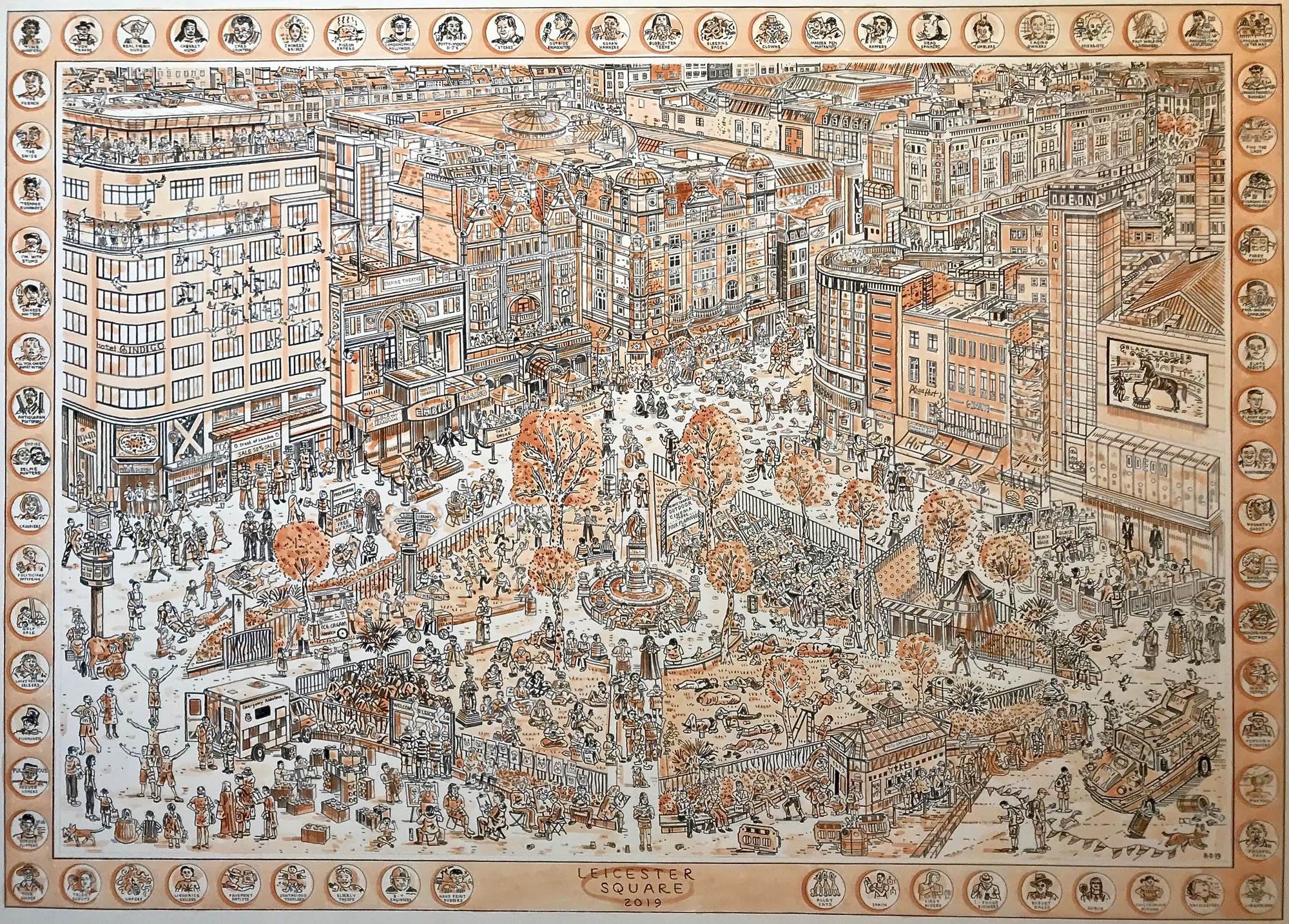
On the other hand, creating bigger artwork can be an opportunity to include more details for some artists. Adam Dant (www.architectural-review.com/today/adam-dant-the-budge-row-bibliotheque) and Andreas Gursky (www.bbc.com/culture/article/20151106-andreas-gursky-the-bigger-the-better) create images that stand out because of the surprising level of details they contain and this can only work on a larger scale. The Boyle family (www.luhringaugustine.com/exhibitions/boyle-family#tab:thumbnails) zoom on a piece of earth and recreate it.
For all these artists, working on a bigger scale represent particular challenges. This can involve some preparation in a smaller size. Emma Stibbon draws smaller sketches before working on her final artwork. The work will be more physical. The challenges will be different for Andreas Gursky as he tends to work digitally but even in that case, working on a computer on an image that will be printed on a much larger scale will present its own difficulties.
I reallly like the work of Adam Dant and how he depicts so many scenes and story in one big drawing.
How do they choose their subjects?
Adam Dant’s work is often about London and its history. In a series of maps of London he created (https://www.theguardian.com/cities/gallery/2018/jun/22/hand-drawn-history-london-adam-dant-maps-in-pictures), he explored the rich history of different parts of London. On a website about the life in Spitalfields (https://spitalfieldslife.com/2021/02/24/adam-dants-london-squares/), he describes in great details the different scenes taking place in his series of illustrations called “London Squares”. It shows how much research he puts in his drawings and his sense of observation of the places he choses to illustrate.
He is often compared to the illustrator William Hogarth. William Hogarth also “chronicled the world around him” (https://www.christiesrealestate.com/blog/in-the-studio-with-artist-adam-dant/). In many of Adam Dant’s drawings, we can feel the same exuberant activity and the same wealth of information contained in every part of the illustration.
How do their creative and material approaches differ?
In Adam Dant’s work, we can notice how there is a main “structure” around a perspective, a diagram or a map. He then fills the drawings with details, from carefully drawn buildings to multiple scenes of people interacting with each other. I particularly like his use of perspective in some of his illustrations such as the Budge Row Bibliotheque (https://www.architectural-review.com/today/adam-dant-the-budge-row-bibliotheque) or Leicester Square (https://spitalfieldslife.com/wp-content/uploads/2021/02/Leicester-Square-1.jpg).
Why do they make their work at a large scale?
Adam Dant’s drawings could not really be on a smaller scale as the details would be lost. As mentioned before, each drawing is a multitude of illustrations in one big image.
What hurdles have they encountered or initiatives have they had to develop in order to produce their work?
Working on a larger scale would involve a lot of preparation. Also, it can sometimes be more challenging to work on a larger piece as some areas of the artwork might be more difficult to reach and it can be more physical. We can see how the artist works on Christie’s timeline on this website: https://www.christiesrealestate.com/blog/in-the-studio-with-artist-adam-dant/.
 Catherine Roux Degree in Illustration