In order to decide how to approach this exercise, I started researching artists who explored the notion of time and its impact on their artwork.
I have noticed how many artists have experimented with the impact of nature on their work over a period of time. The sculptures created by Jason deCaires Taylor under water are constantly modified by erosion, vegetation and animals. A similar transformation happens with the life size figures created by Anthony Gormley. As for the series of sculptures titled “Lives of grass” by Mathilde Roussel, they are living sculptures as they evolve as the grass grows.
Destruction is also a theme explored by many artists including Gustav Metzger (1926-2017) who uses acid to partially destroy or transform his artwork.
I liked the idea of superimposing images or playing with scales when I looked at Duane Michals’s work (https://www.dcmooregallery.com/artists/duane-michals?view=slider#6). I considered using this method as an inspiration, potentially playing with photos from different periods.
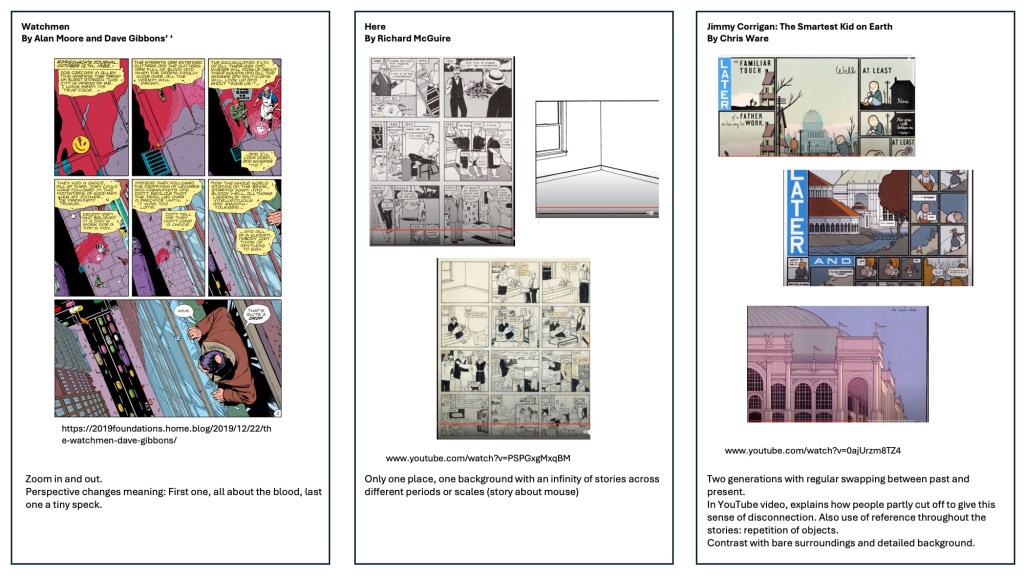
However, after looking at some graphic novels where the element of time plays a dominant role, I decided to focus on this approach. I looked at how artists have used different techniques to tell their story.
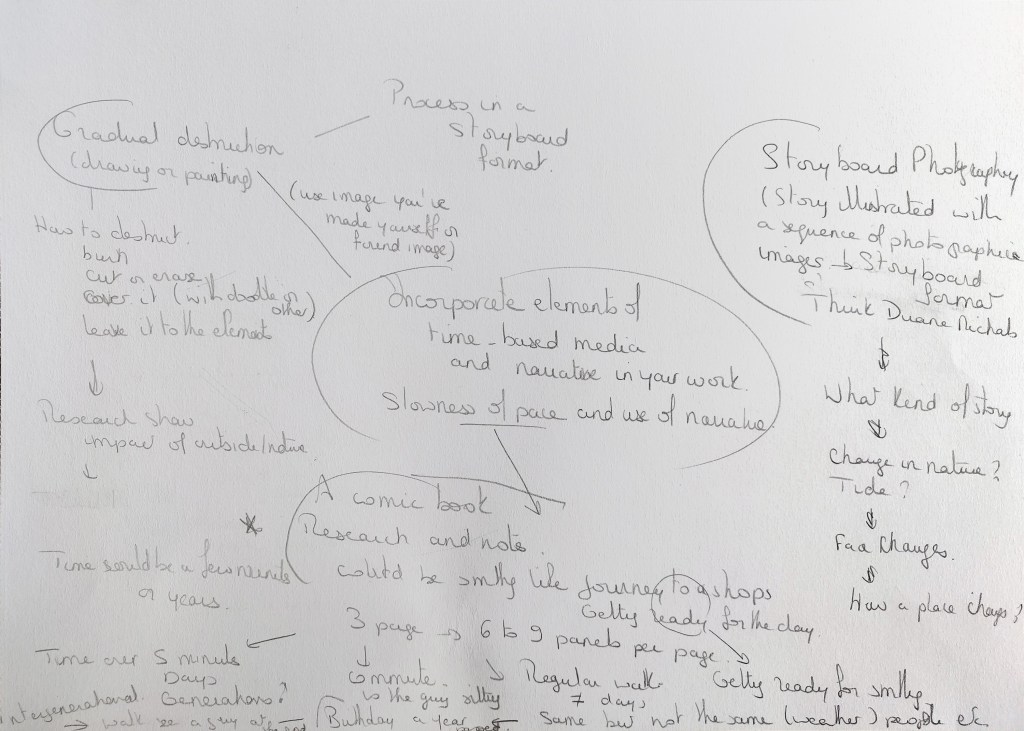
I wondered how to include a routine in my story. I considered commuting, getting ready for work and other activities that are part of everyday life. As part of my routine, I like going for a walk and thought this could have some potential for a story. I added a dog as they are many people walking their dogs around my home.
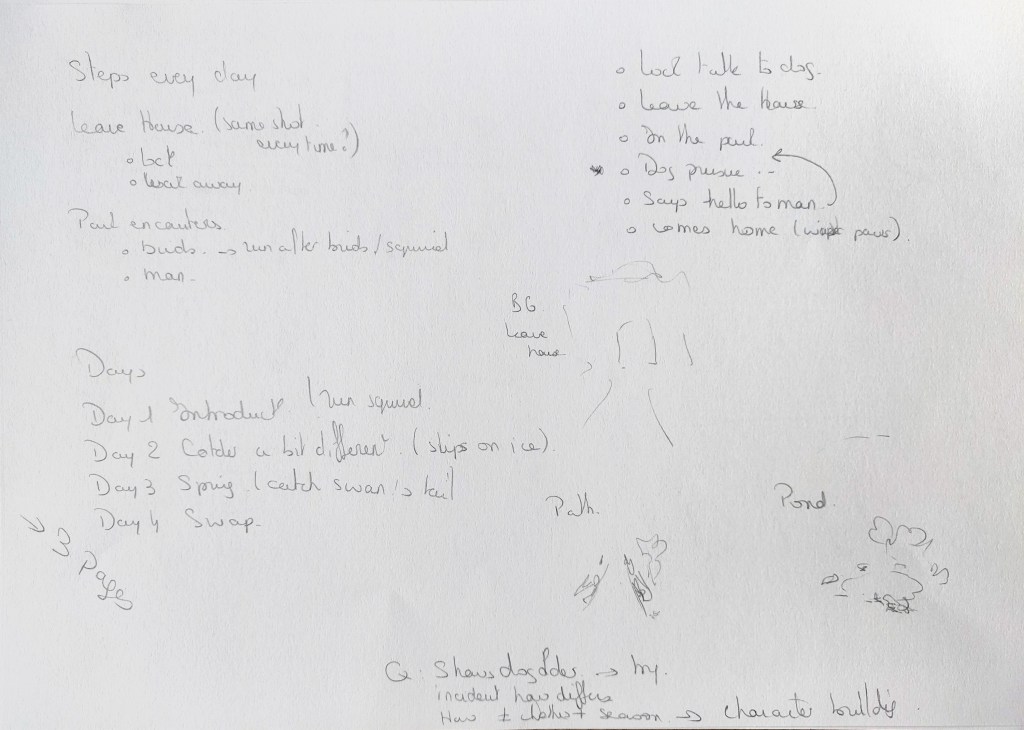
Once I decided on a subject, I created some thumbnails. I had to do several versions as I developed the story.
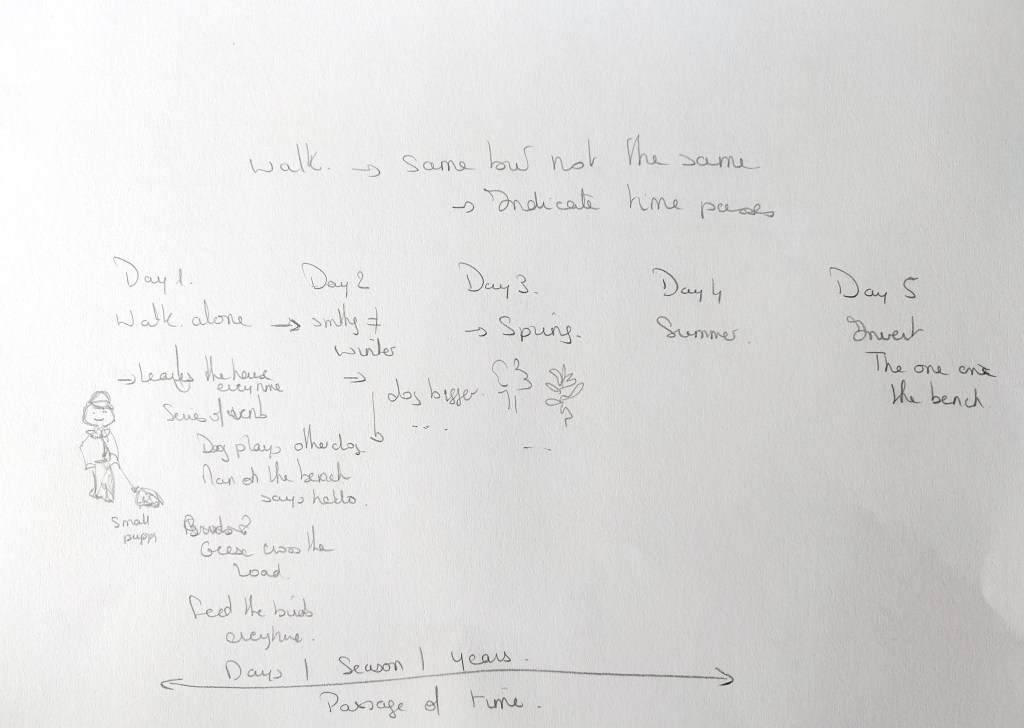
I first used my sketchbooks to explore the different options for this project and experiment with the main characters and backgrounds for the story:
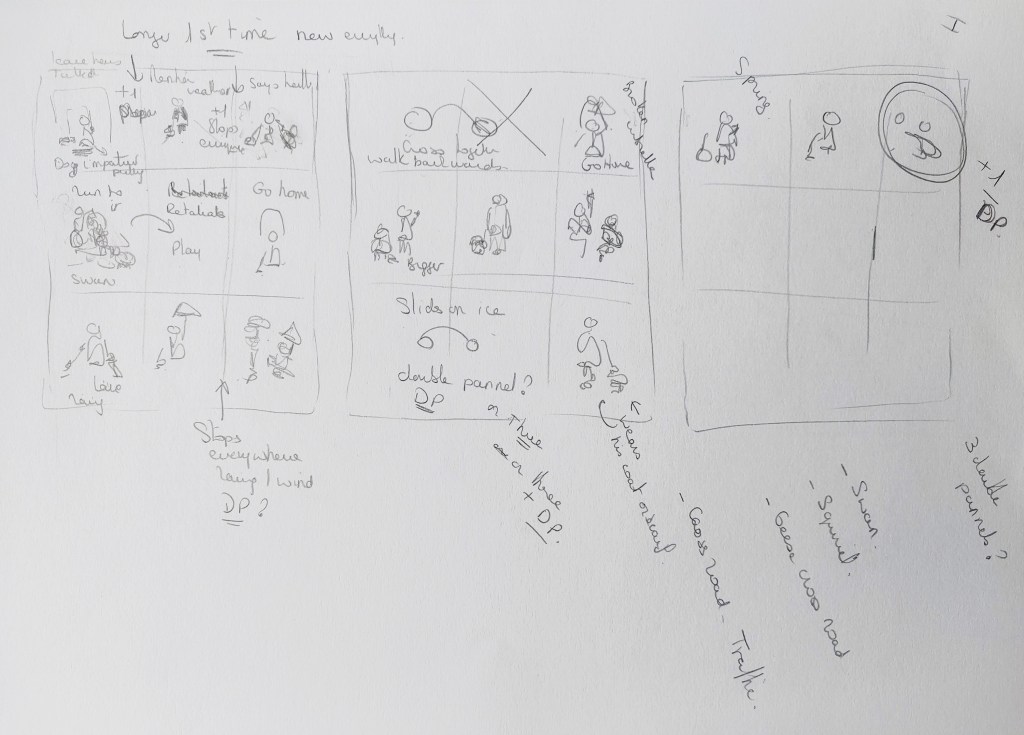
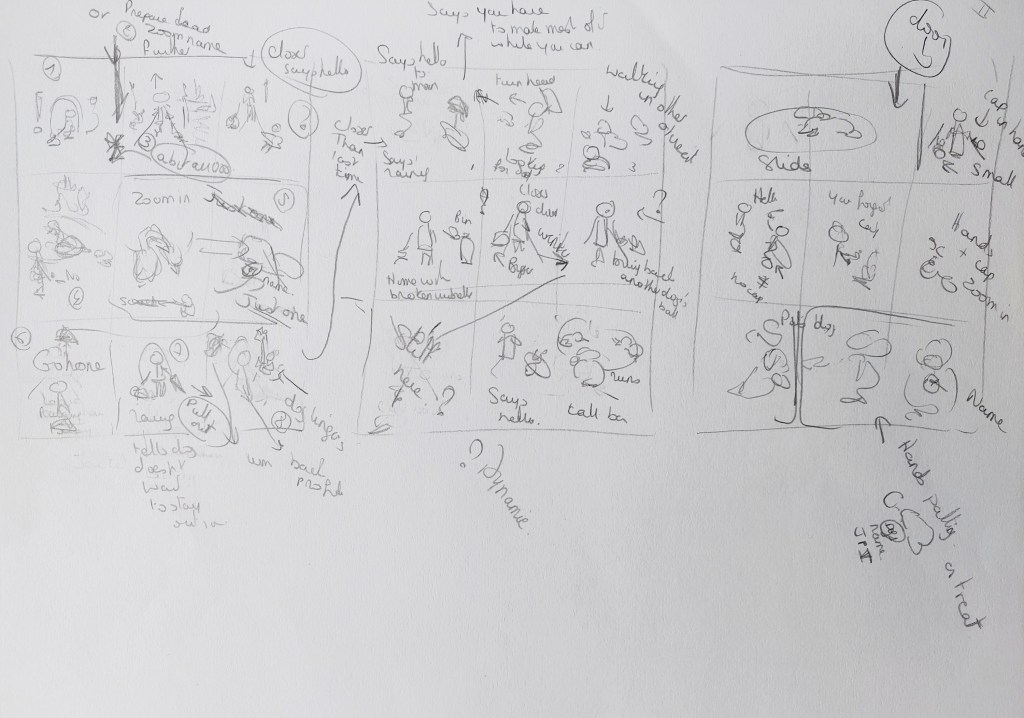
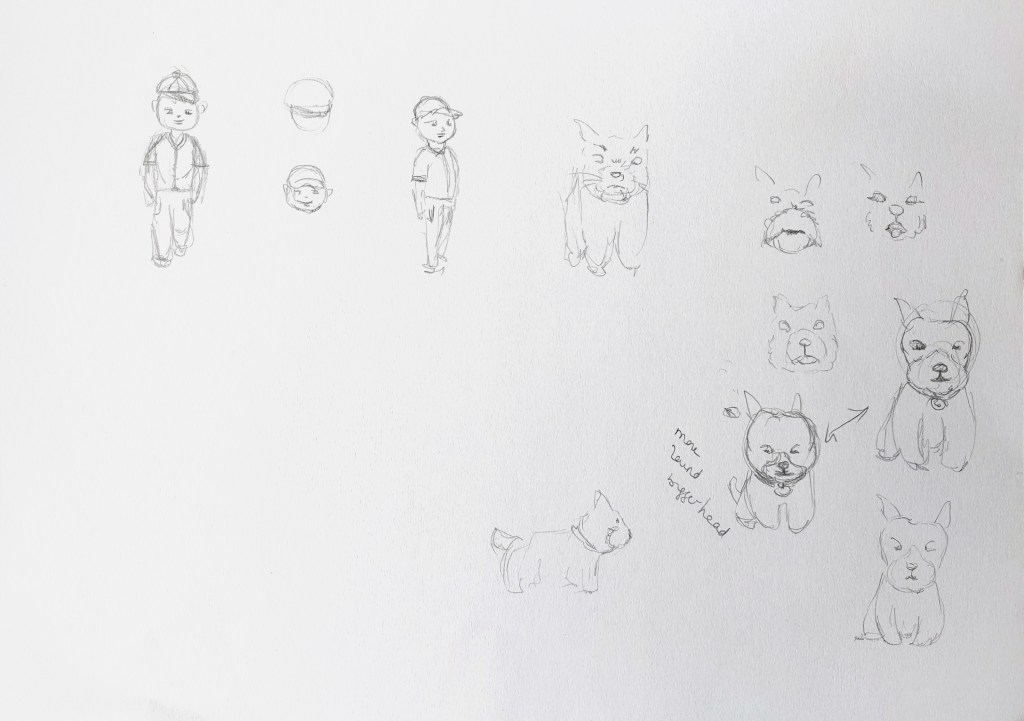
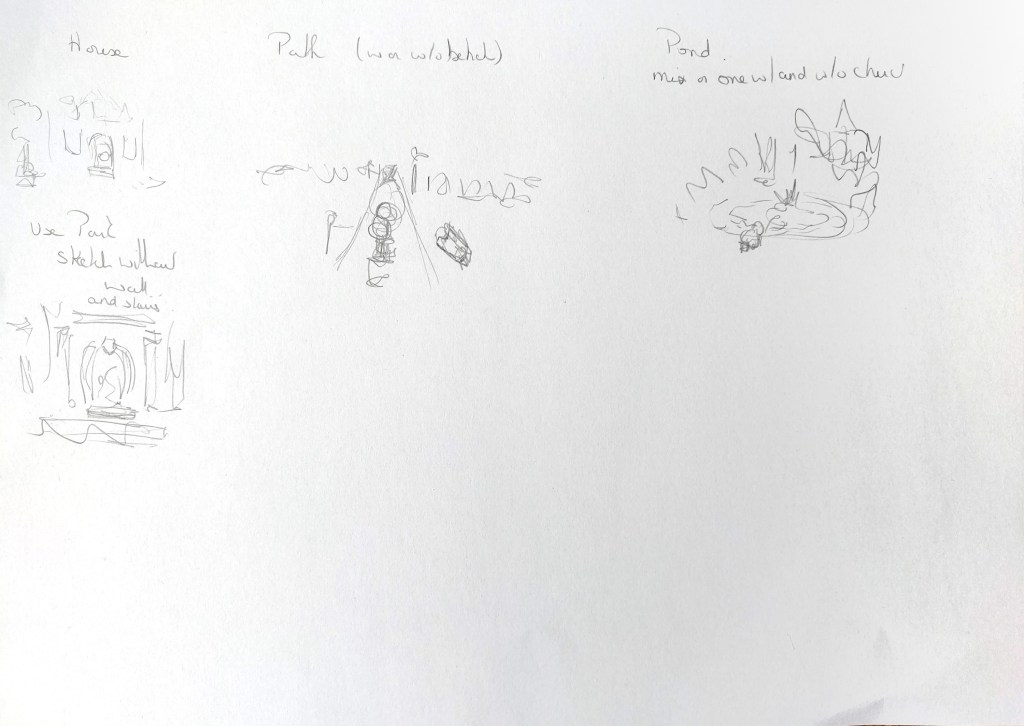
I then worked in Procreate. I chose a colour palette to visualise what the outcome would be. This is the work in progress of page 1.
I added the callouts with the dialogues in Illustrator. This is the final story:
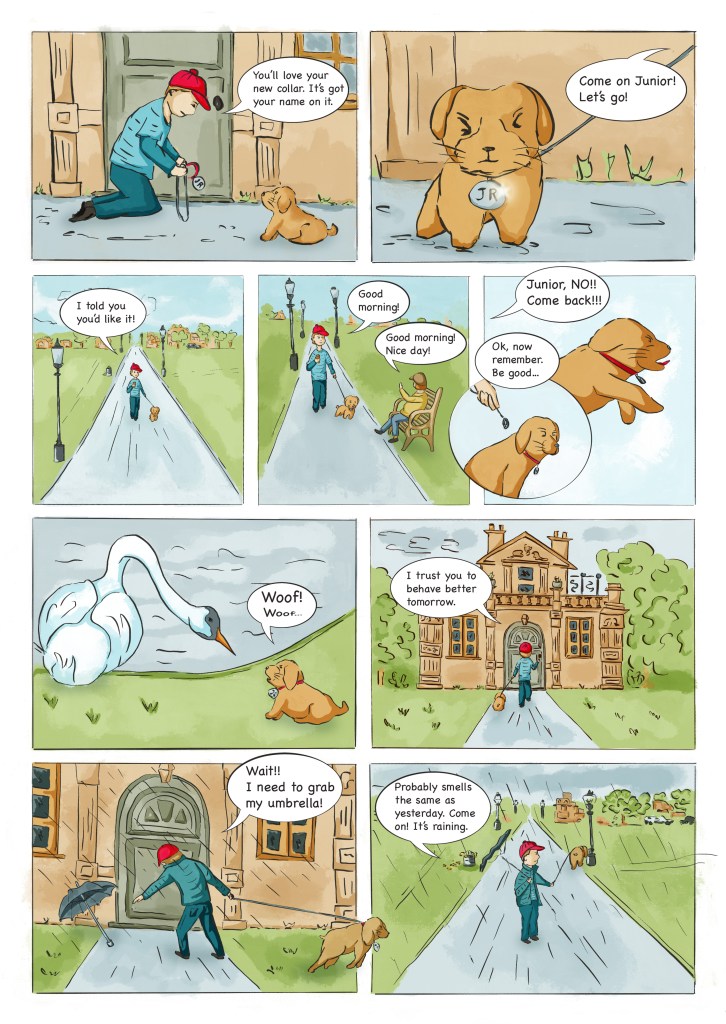
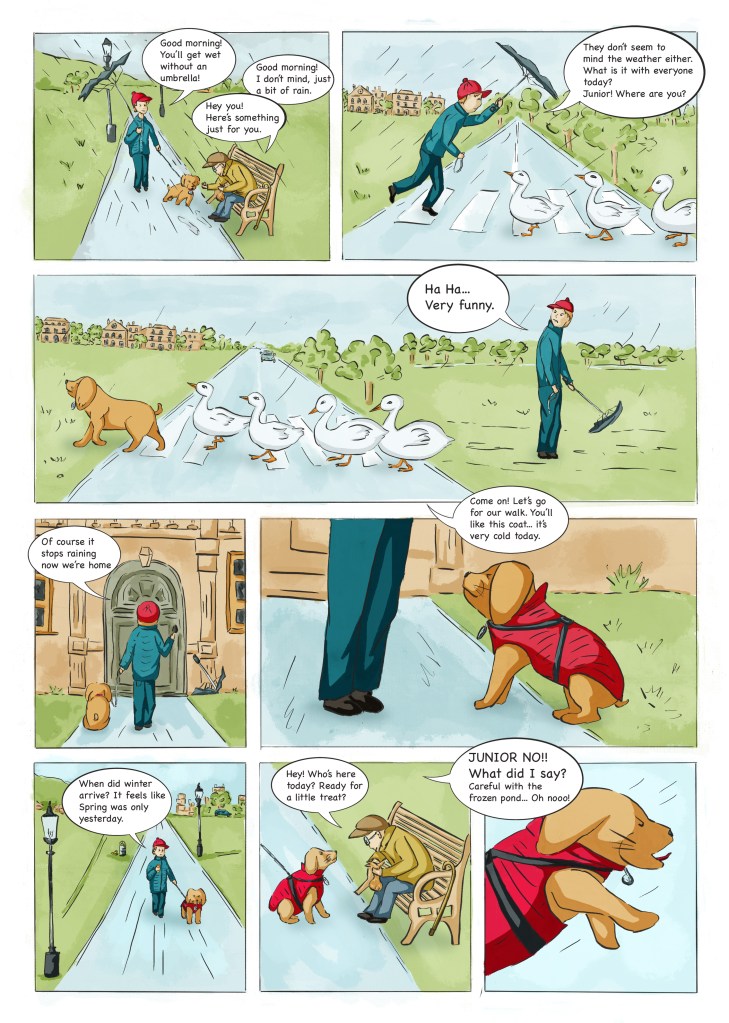
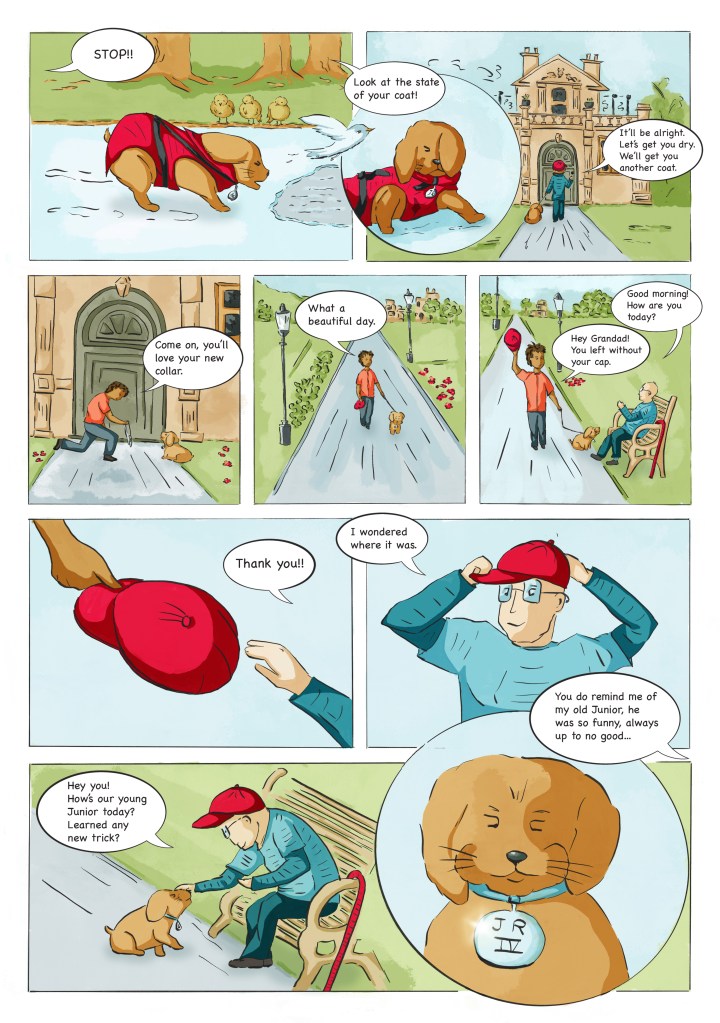
The idea was to repeat the walk several times and make it look as if nothing important happens. However, at the end of the story, the reader realises that what seemed to happen over a few days actually took many years and the young man from the beginning has become an old man. As for the dog, this is not the same one. I used the idea of repetition. At the beginning of each day, the main character leaves the house, he then walks along the same path and comes back to the house. To indicate the passage of time, I have also included some clues. There is a mention of the seasons passing on page 2 (“It feels like Spring was only yesterday”). I have used colours as codes: the red cap, the blue outfit.
In a way, the dog is a distraction. In order to make something happen within the main story (the passage of time), I have added incidents where the dog misbehaves.
Halfway through my work, I realised that I had worked on that theme before (a dog’s walk). However, the approach was different. The story was seen from the dog’s point of view and it was not about the notion of time (https://catherinerouxillustrationdegree.uk/illustration-year-2/responding-to-a-brief/coursework/part-4/exercise-self-publishing/). It was also meant for a younger audience. However, once I had finished, it was interesting to compare both pieces. I had learned a lot from the first exercise and other experiments with graphic novels that I tried to put into practice this time.
I have paid more attention to details. This included some backgrounds. I took inspiration from the detailed architecture in “Jimmy Corrigan: the Smartest Kid on Earth” (Chris Ware) and spent some time to decide on the house where the main characters would live. I looked at various images and actually used a sketch of a building in Greenwich Park that I had made and adjusted the building to turn it into an individual house. I also added details in places such as the three little birds watching when the dog is sliding across the frozen pond (page 3).
I tried to create some interaction between the frames to emphasise the idea of movement. On the last page, the bird is flying across frames for instance. I worked with a grid when I created the frames to keep a sense of harmony.
I also made sure that I zoomed in and out to add some energy to the story.
I have encountered a few challenges.
I had to readjust the storyboards a few times. As I developed the story and created more detailed drawings, I could see how some modifications were needed in some places.
The biggest challenge was probably to be consistent. I was trying to picture a dog that would grow up and then be a puppy again as the story spans over several generations of dogs and I found it a bit difficult. Procreate helped to keep the frames consistent as I could use a previous scene in the background to check proportions,…
I still struggle with the thickness of lines. I tried to apply a thicker line to indicate details such as shadows but I did not always succeed as I was trying to get many elements right.
I took inspiration from the previous exercise that consisted in drawing without lifting the pen to create the initial sketches in order to avoid hesitant lines.
I do not remember doing an exercise specifically based on a particular pace to follow. I found it very interesting because even when the notion of time is not the dominant part of the story, it is always something to take into account as the story develops and I enjoyed looking for solutions to indicate a new day, follow a given rythm and give clues to the reader to indicate the passage of time.
 Catherine Roux Degree in Illustration