For this exercise, I chose the word “Seed”.
I took an A2 page and created a spider diagram.
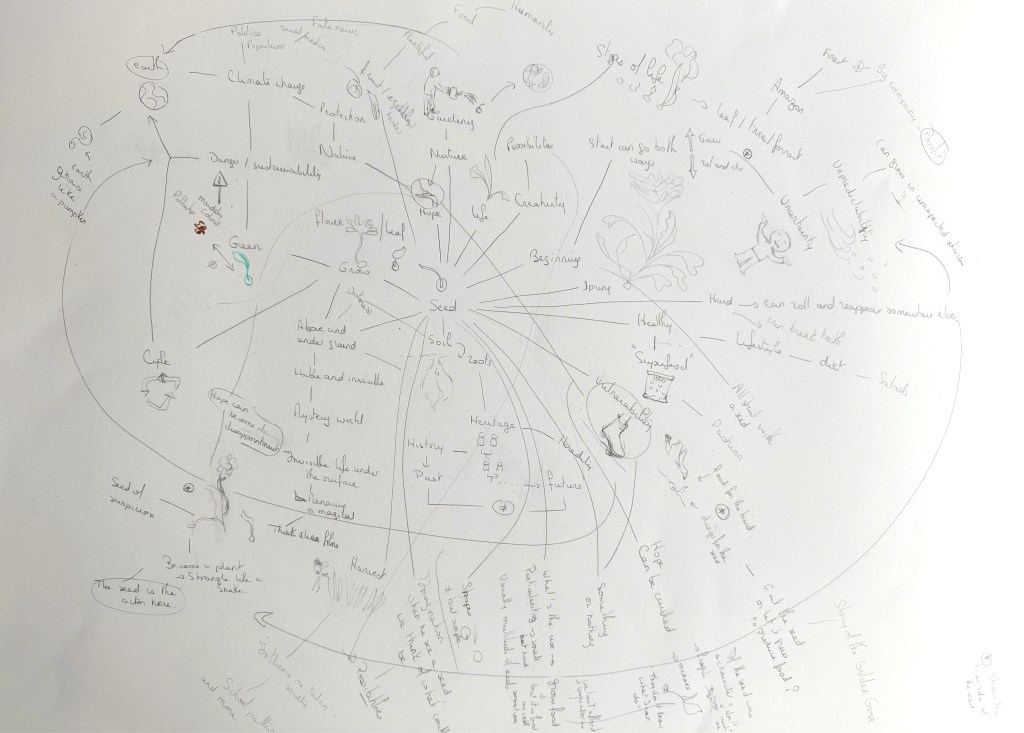
At first, I stayed around the concept of the seed but I then tried to push my ideas further to see what would come out of it. I asked myself some questions about seeds, their use, where they come from, their future. I looked at Google images. I also searched the definition and synonyms of the word for inspiration.
Once I felt that I was not adding anything new anymore, I tried, as suggested, to identify some concepts in the diagram that were more distant from the original word and created another diagram, aiming at finding some connections between these concepts.
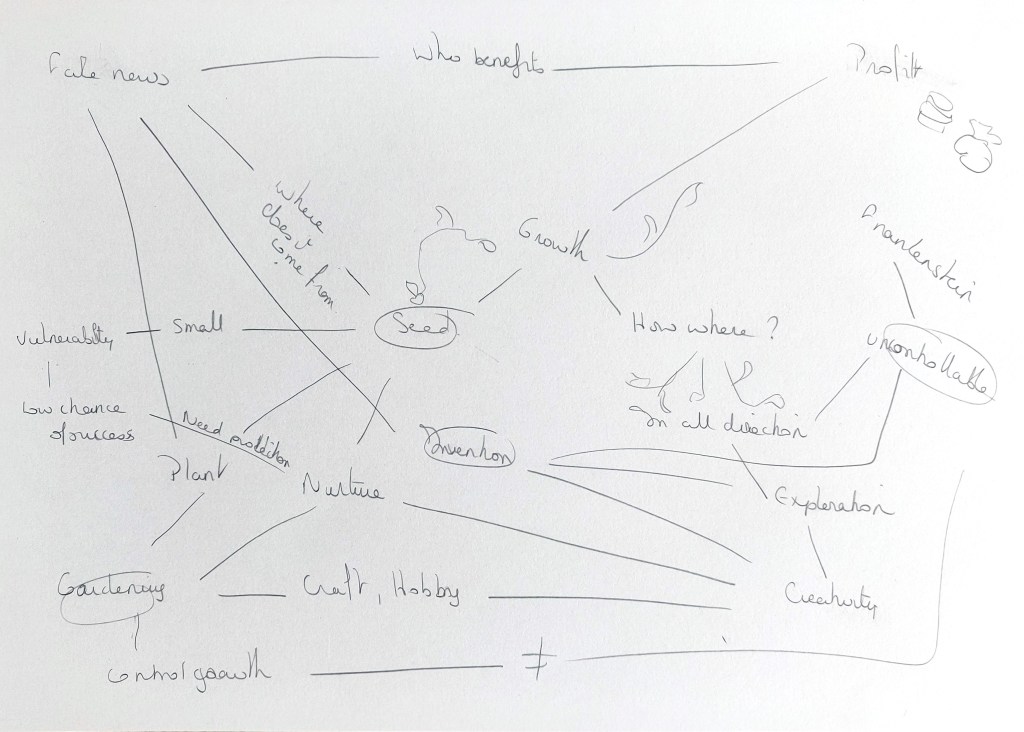
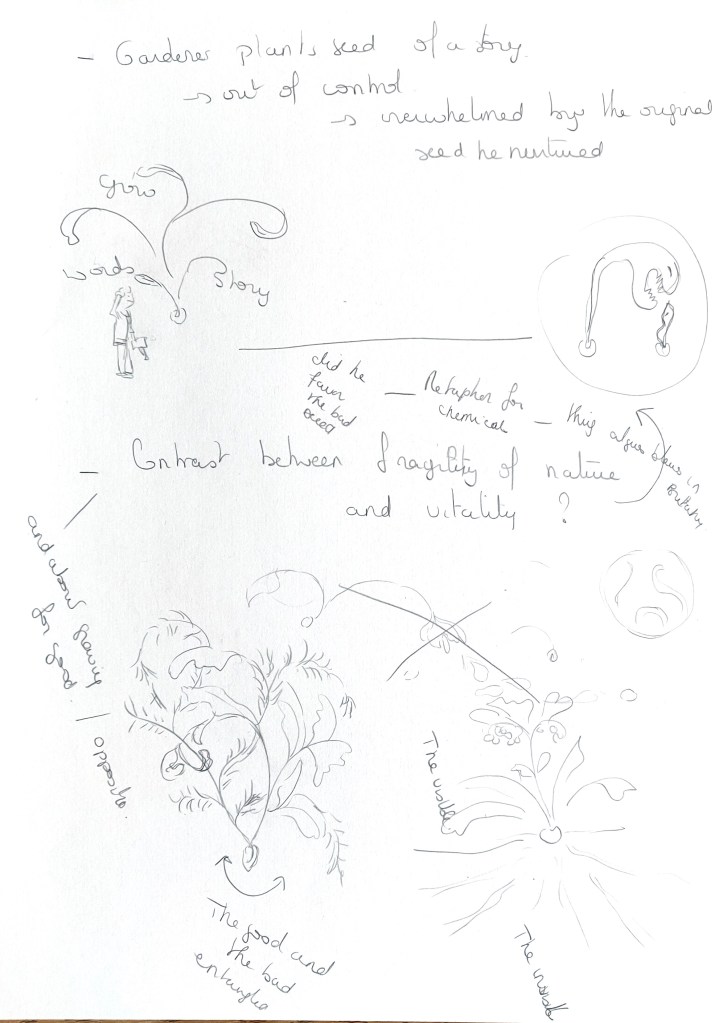
I wondered which concept would be the most interesting to explore further. There was this idea of the seed that can both be seen as vulnerable and represent the fragility of the world and unpredictable and could therefore be a menace. I thought of alien films where the seed turns into a dangerous alien ready to take over the world.
I explored this idea in a sketchbook. At first, I thought of the bad and the good side of the seed represented in a plant with entangled branches. I then imagined a seed turning into a dangerous plant that would threaten the gardener (humankind), the fragile seed (other plants) and insects. Next to the gardener, there would be a bag of chemicals indicating that he is responsible for this monster. It could be a series of illustrations around a story or just one illustration.
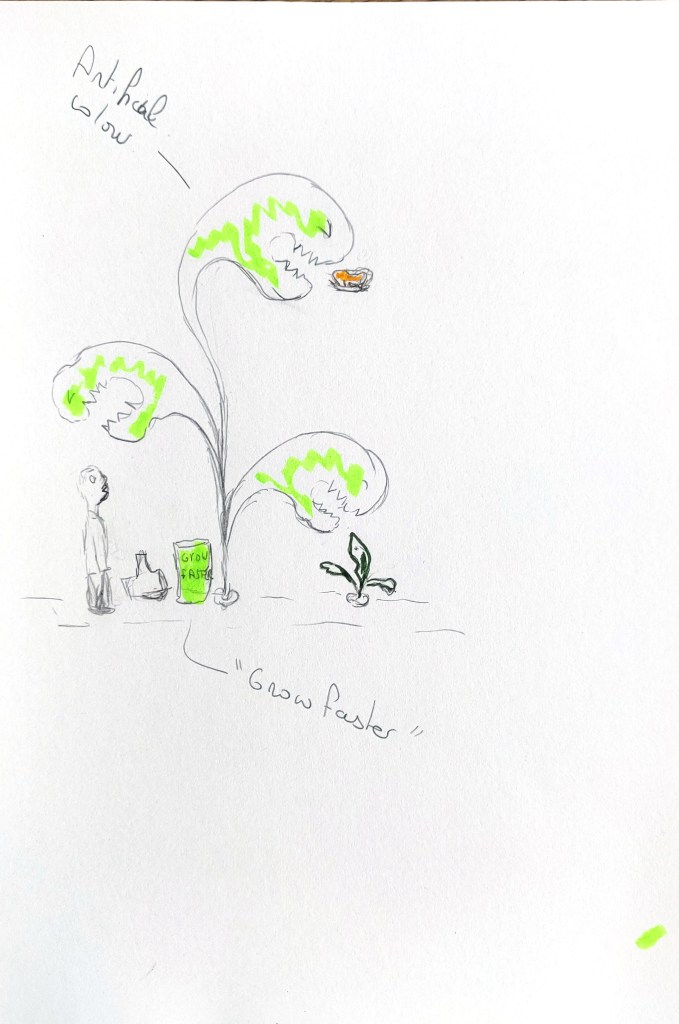
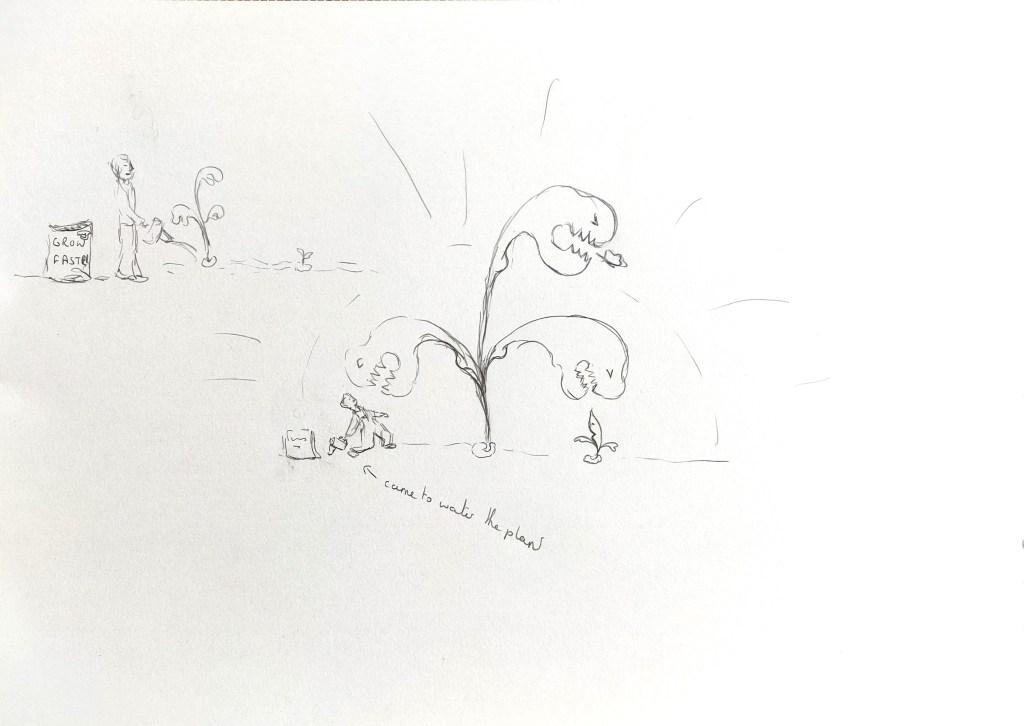
In retrospect, I wonder if I was inspired by a story I heard about a type of algae in Brittany that are known to be deadly and are the result of intensive farming (https://www.theguardian.com/environment/2019/sep/08/it-can-kill-you-in-seconds-the-deadly-algae-on-brittanys-beaches).
I struggled with this exercise. On one hand, I feel that pushing the spider diagram further helped me to develop more ideas. On the other hand, I wonder if I could have pushed the ideas further to develop more interesting and surprising concepts and designs.
Before starting my spider diagram, I had revisited the concept of divergent thinking in a book called The Graphic Design Process – How to be successful in design school (Nottingham, A. and Stout, J. (2019). The Graphic Design Process. Bloomsbury Publishing. pp. 69-92).
Once I had completed the exercise, I thought again about the techniques I used: I tried to ask questions; I took a break and came back to the diagram; I tried as suggested to add new concepts more distant from the original.
As suggested in the book The Graphic Design Process, the fear of being wrong might have held me back to a certain extent.
I did some more research on lateral thinking techniques to see if I could have done things differently. I found some interesting suggestions on the following website: https://www.betterup.com/blog/what-is-lateral-thinking. I particularly like how they illustrate the idea of adding a completely different concept to the original and trying to link the two: “Imagine you’re […] working on a rebrand for a coffee shop. To provoke a new idea, you randomly select a word from the dictionary: “spine.” You map out different word associations to “spine” and end up creating a new brand based on the idea of coffee as a backbone.”
This exercise has helped me to understand better how I could use spider diagrams in a more effective way in order to generate ideas.
 Catherine Roux Degree in Illustration