There might be multiple reasons to explain how a popular story ends up being associated with a particular illustrator even when several artists have illustrated the story over the years.
This might have something to do with the reasons the writer chose an illustrator in the first place.
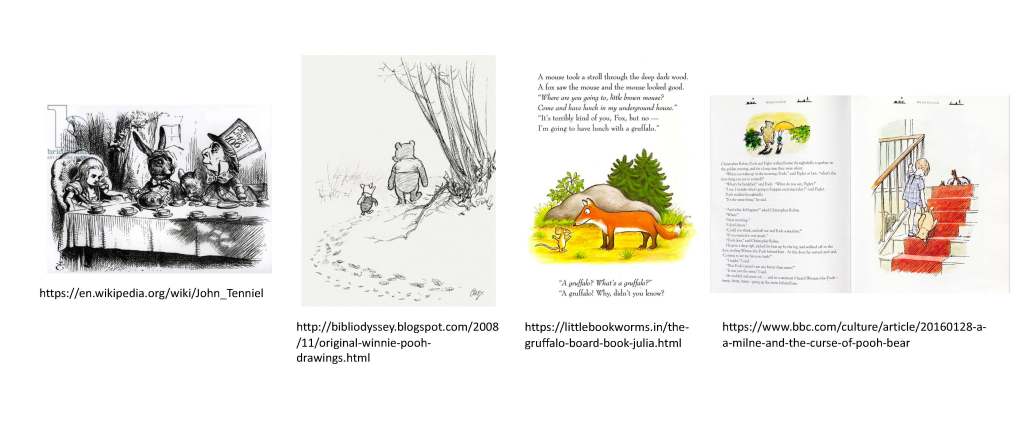
According to an article in Wikipedia, Lewis Caroll chose John Tenniel to illustrate his stories because of his “grotesque” style (https://en.wikipedia.org/wiki/John_Tenniel).
John Tenniel worked for the magazine Punch for several years and had developed strong caricaturist skills. By playing with proportions and expectations, John Tenniel created striking illustrations that enhance a story where objects come to life, animals talk and proportions are constantly changing with Alice’s size. In the examples below, the queen’s head is big compared to her body and all the features are accentuated. The image on the right is a good example of John Tenniel’s caricatures and we can see how this style works well with Lewis Carrol’s stories.

Sometimes the illustrator has a style that is easily recognisable and when there is a strong collaboration across several books, the illustrator and the writer might be associated in people’s minds.
Quentin Blake illustrated 18 of Roald Dahl’s books and his style is quite unique. Although he makes it look easy with quick lines and colours seemingly applied “imperfectly”, he explains on his website how he can redraw the same character many times until he achieves the right outcome. The colours are very vibrant and when explored a bit further, we can see how he use colours or the lack of colours to add highlights and energy to his illustrations.

For the collaboration to be successful, it is important that the style of the illustrator reflects the story and appeals to the intended audience.
Alice in Wonderland might appeal to an older audience than the Gruffalo or Winnie the Pooh and the text is longer and more complex. This is reflected in the illustrations accompanying the text. There is a simplicity in the lines in the illustrations of the Gruffalo or Winnie the Pooh whereas John Tenniel’s illustrations contain many details and are very intricate.
The collaboration between the writer and the illustrator and editor is also very important to achieve a successful outcome.
On his website, Alex Scheffler (https://axelscheffler.com/books-with-julia-donaldson/the-gruffalo) explains that his first sketches of the Gruffalo were considered too “scary for tiny children” by the editor and he had to adapt the shape of his character slightly to make him more friendly. He also discussed some of his ideas with the writer, Julia Donaldson, and they agreed for instance that the animals would not wear clothes. On the other hand, he also mentions how, when he works with Julia Donaldson, they respect each other’s work and work separately (https://axelscheffler.com/any-questions).
Sometimes, however, an illustrator can find it difficult to be associated with one aspect of his work.
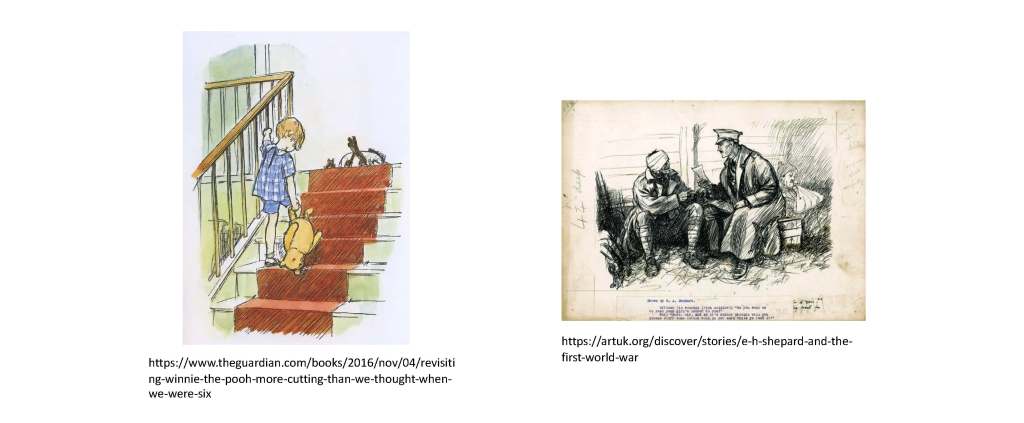
This ended up being the case with E.H. Shepard and Winnie the Pooh. It seems that he ended up resenting being associated with his illustrations of Winnie the Pooh and called his character “that silly old bear” (https://en.wikipedia.org/wiki/E._H._Shepard). E.H. Shepard created many more illustrations including some recording the first world war.
Whatever the reasons for a story to be associated with an illustrator in particular, they all have in common to have been illustrated by talented artists and that explains in great part their success.
 Catherine Roux Degree in Illustration