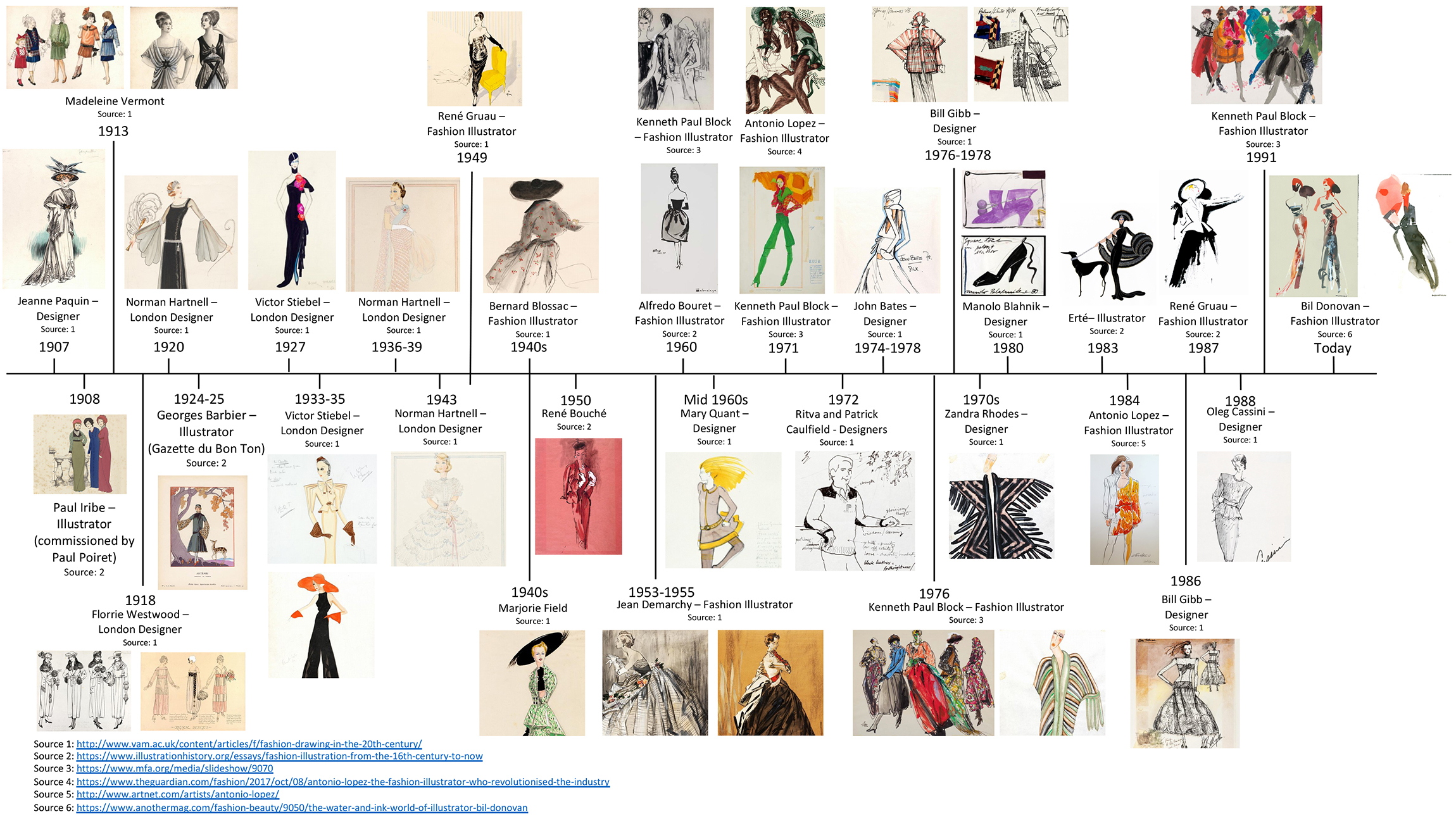
When I started doing some research about fashion illustrations, I found it difficult to see the evolution across the decades clearly although I discovered some interesting articles on the subject (see sources below timeline).
I therefore decided to create a rough timeline that would give me an overview of the changes that have occurred over a century.
I also created a board on Pinterest that kept growing as I constantly had some interesting suggestions on the subject.
To answer the questions about the evolution of fashion illustration in the twentieth century, it is important to understand the purpose of illustrations.
Before the 50s, illustrations were the way to capture the details of a garment (shape, texture, colour, etc.). In a sense, it was the only way to illustrate fashion since photography could not be used so easily in print at the time. But when technology made it possible to use photographs more widely, they were perceived as more reliable to describe the new fashion trends. On top of this, as quality photographs in magazines and other publications were new, they might have been considered more modern and exciting.
However, as we became more accustomed to pictures of very high quality in magazines and online, including special effects and virtual reality, there might be an appetite for the human touch that can be found in an illustration.
Indeed, when I looked at contemporary illustrations, I noticed how they tend to be much more creative. It is not about representing in details and with high fidelity a garment and how it will be worn, but it is more about the sense of movement and the life of colours. Some of these illustrations contain a few strokes and are meant to trigger our imagination.
This trend seems to have started before the 90s but it would have been less commonplace. The work of Kenneth Paul Block for instance spans over several decades and is very modern with its dynamic shapes and quick strokes.
In contrast, illustrations at the beginning of the 20th century tended to be more traditional and often more similar to a photograph, describing the garments and the models with accuracy.
The way people are represented is also different because society has changed. This includes the role of women for instance. In old illustrations, women were often represented in a bit of a static and conservative posture.
Nowadays photography and illustrations co-exist and are complementary.
 Catherine Roux Degree in Illustration