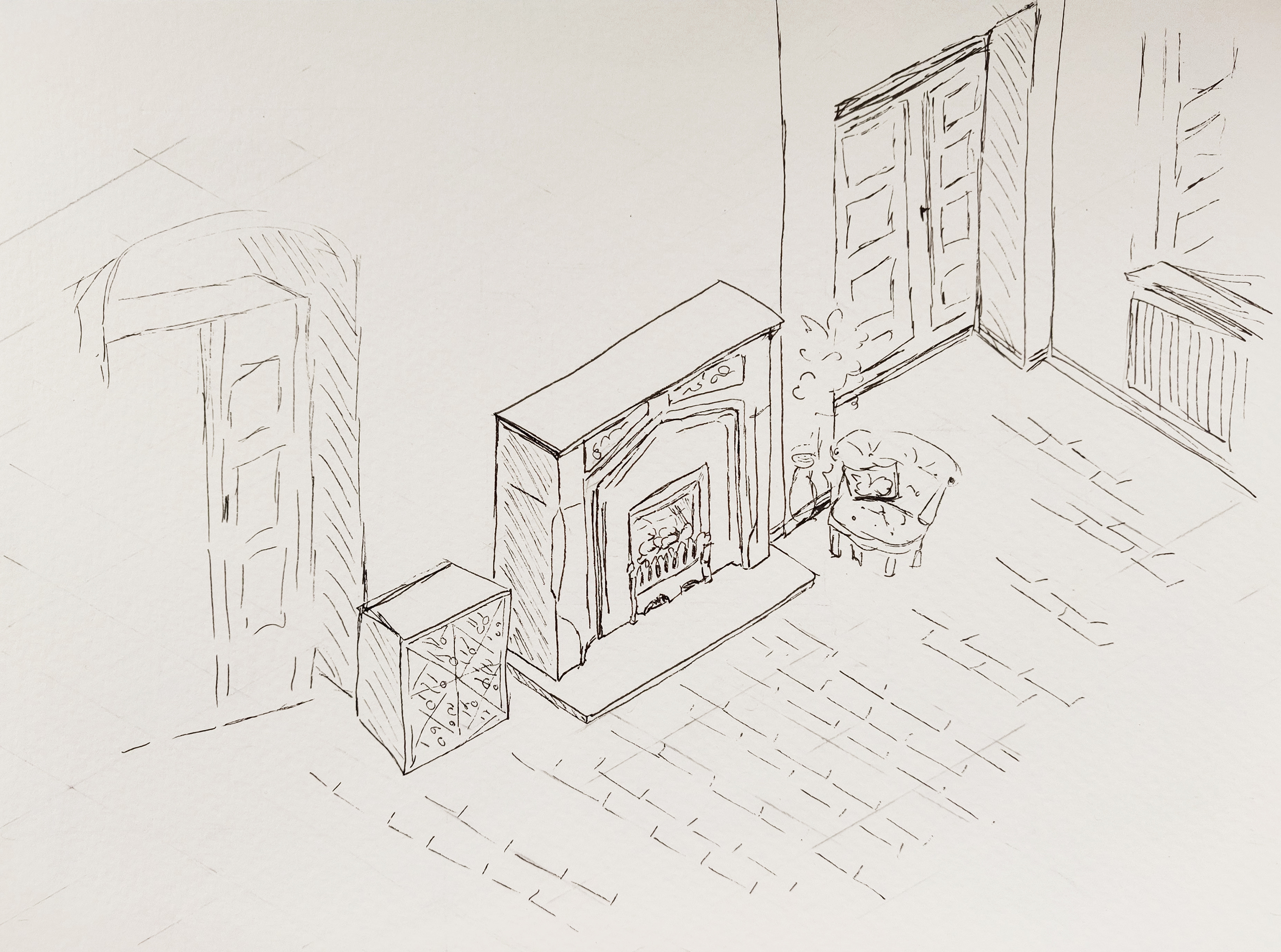
I needed to refresh my memory regarding the different ways to capture perspective in a drawing and viewed a few videos on YouTube on the subject. I particularly had to research isometric projection as I had never used that technique before (https://www.creativebloq.com/features/isometric-drawing).
I chose the fireplace and its surroundings in our home. It meant that I would have enough space to draw this area from different angles and viewpoints.
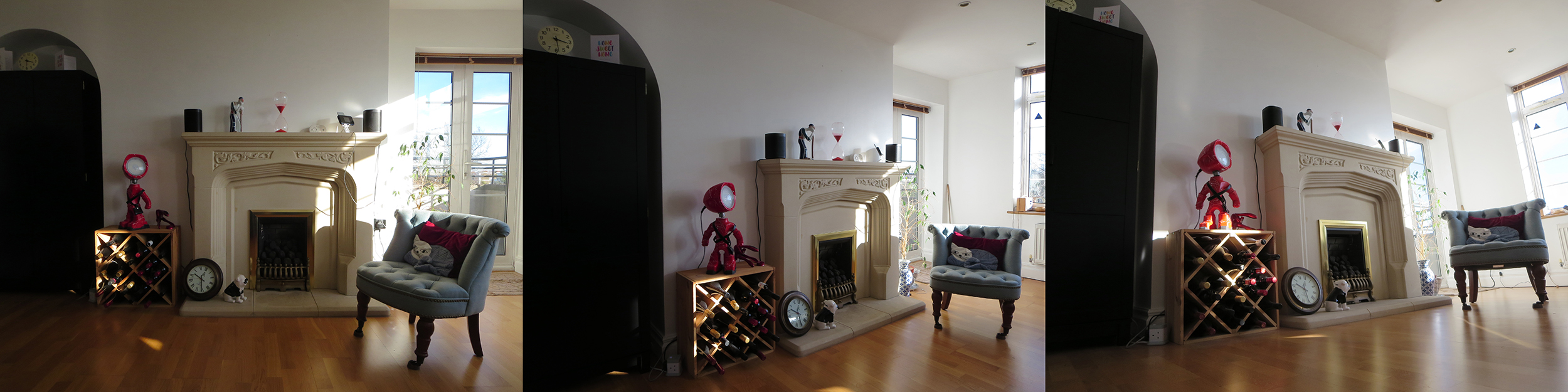
For each drawing, I started with a pencil to get the main shapes and carried on with a black fine liner. For the isometric projection, I drew a grid to use as a guide first.
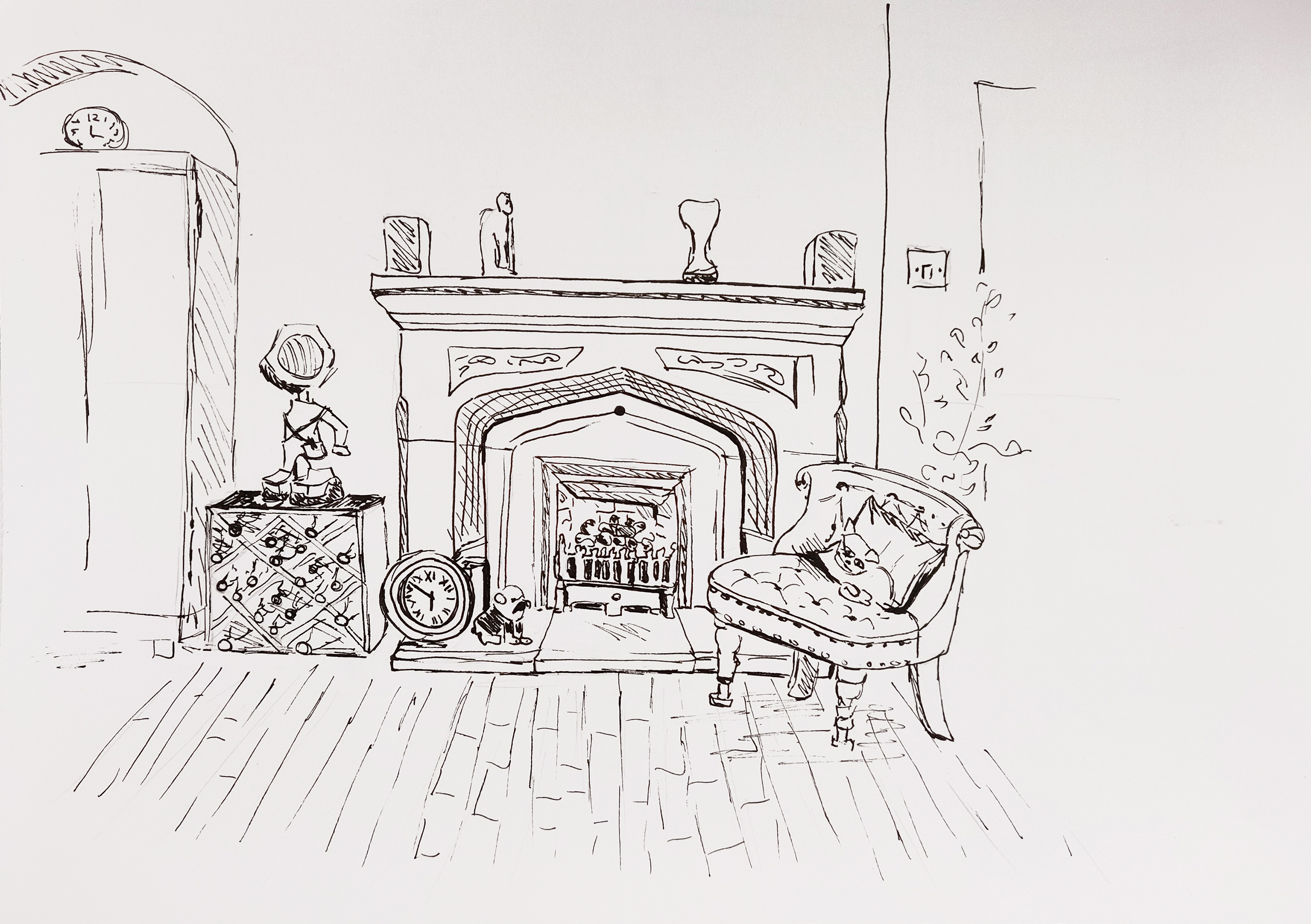

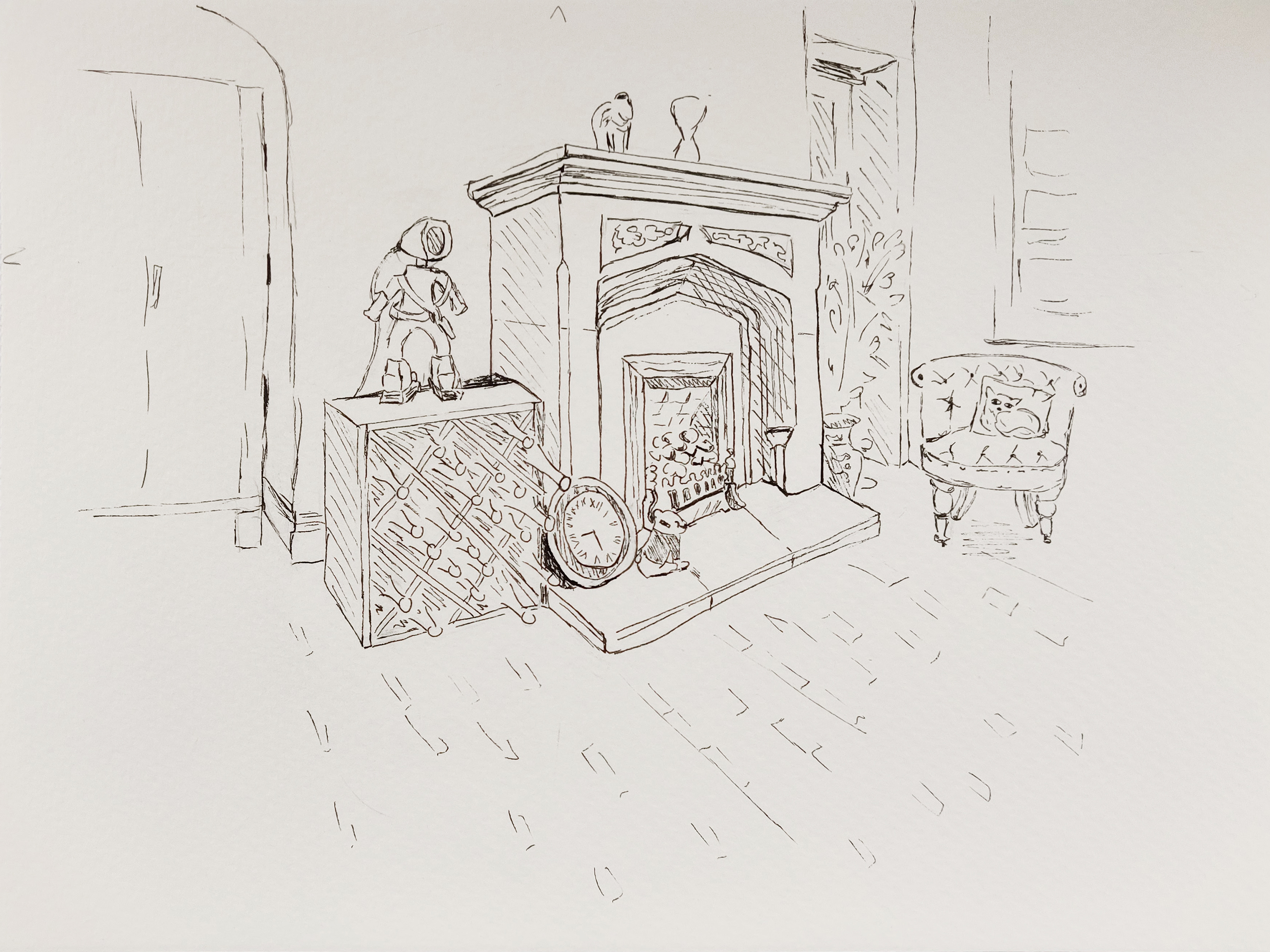


I struggled to find a viewpoint that would be suitable for a three-point perspective and I am not sure that I succeeded. I tried to be in a position where I would see the fireplace from below but there is not enough contrast in size between the bottom and the top of the fireplace to fully show the perspective. It is not obvious that there would be a vanishing point above the fireplace (as would be the case from the bottom of a building for instance).
For the drawing where I broke the rules, I applied different perspectives and viewpoints in the same drawing. As it ended up looking unrealistic, I wondered in which circumstances I would use such a technique. I used the lamp (in red) as a character that would have landed and created chaos with the dimensions of the room.
One of the difficulties I encountered with two-point and three-point perspectives was to imagine the vanishing points outside the page.
When you choose to draw with or without perspective what is this saying?
The use or absence of perspective in a drawing will have a very significant impact on the outcome.
Perspective adds realism to a drawing. We do not perceive the world as flat. The depth created by the use of perspective will make a drawing more realistic. On the other hand, flat drawing can be interesting as it breaks the rule but, to be successful, it has to be done consciously.
Perspective also adds movement to a drawing. That is particularly true with some extreme viewpoints. For instance, a worm’s-eye viewpoint might illustrate how impressive a building can be.
The choice of perspective and viewpoint tells a story. It can position the character as very small on the scene for instance or the opposite.
Each type of perspective has its advantages: A one-point perspective can be more static and might suit a scene by a fireplace where the characters are sitting for instance. A two-point perspective could be a good way to illustrate action, such as a race past the fireplace. A three-point perspective tend to accentuate the size of an object.
Isometric projection is slightly different but when I researched it, I notice how often it is used for infographics. It can be very effective to illustrate the different layers of a process.
In summary, perspective adds life, depth, realism and sometimes a sense of drama.
Conclusion
Drawing the same scene using different perspectives has been both challenging and interesting. I had to consider the different angles and why I would use a perspective rather than another one. I particularly enjoyed trying to find unusual viewpoints to draw the scene.
When I drew the scene in a three-point perspective, I wondered if it would have helped to take a photo from an unusual angle but then it would not have been a life drawing anymore.
I feel that I now understand better the advantages of a viewpoint over another depending on what I want to express and this will be very useful in the future.
 Catherine Roux Degree in Illustration